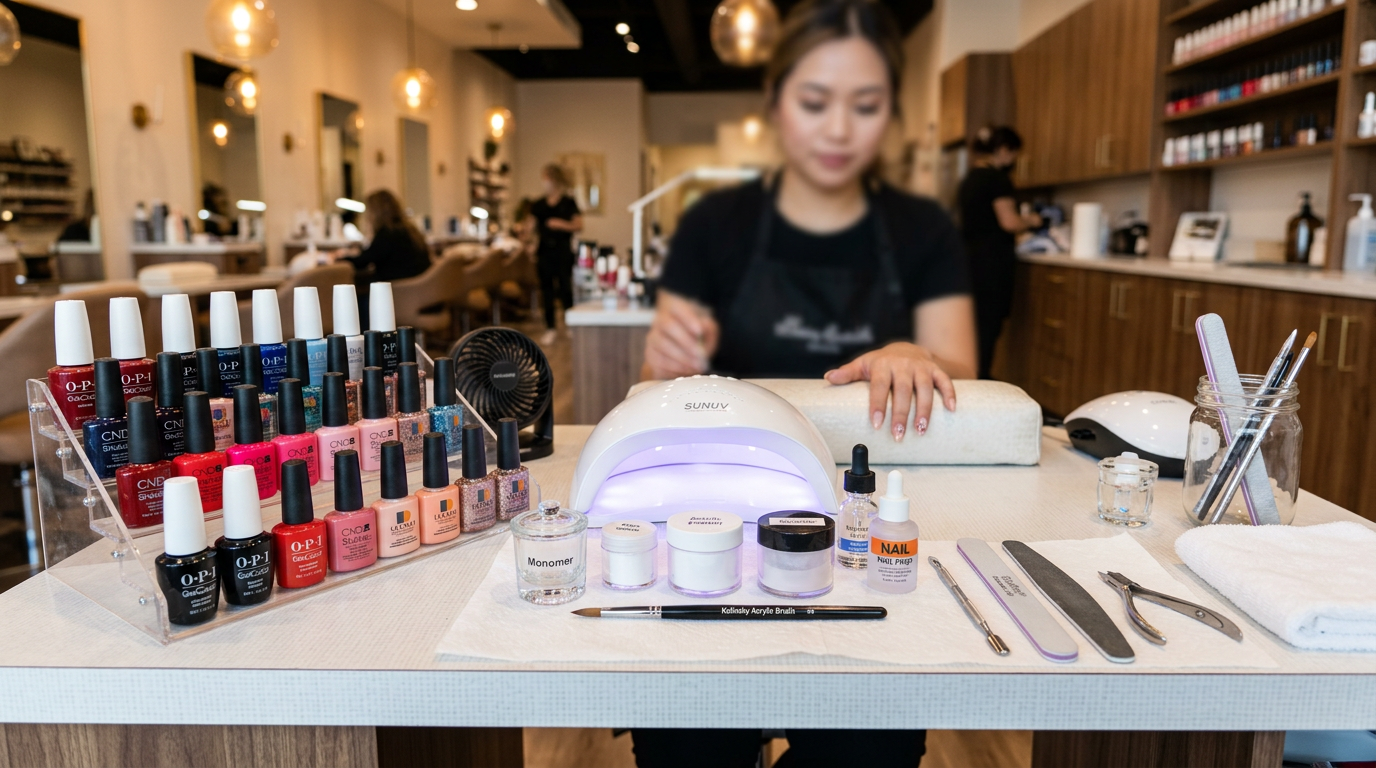
Every nail technician fields the same question at least once a day: “Should I get gel or acrylic?” The honest answer is always “it depends.” Your job is to figure out what it depends on for each specific client. Here is a framework for making that recommendation with confidence.
The Core Difference: Chemistry and Application
Acrylic nails form when a liquid monomer (like Young Nails Monomer) reacts with a polymer powder, creating a hard protective layer that air-dries on the nail plate. Gel nails use a pre-mixed resin that stays workable until you cure it under a UV or LED lamp.
This chemical difference drives every practical tradeoff between the two systems.
Service Time and Scheduling Impact
Time is money in a salon. A full set of acrylic nails typically takes 60 to 90 minutes, while a gel set runs 45 to 60 minutes. That 15 to 30 minute gap matters when you are booking a full day.
If you can fit one extra gel appointment per day compared to acrylic, that adds up. With gel manicures averaging $35 to $80 per appointment (Zenoti), even one additional client per day at $50 means an extra $250 per week. Over a year, that is roughly $13,000 in additional revenue from the same chair.
Acrylic fills run $25 to $40 and are needed every two to three weeks. Gel manicures cost $35 to $50 and need rebooking every two to three weeks as well (Young Nails). The per-service revenue is comparable, but throughput favors gel.
Client Lifestyle: The Decision Filter
Rather than defaulting to your own preference, run through these lifestyle questions during consultation.
Recommend acrylic when the client:
- Works with their hands frequently (acrylic’s rigid structure handles physical stress better)
- Wants dramatic length or heavy nail art (acrylic provides a stronger base for sculpting and 3D designs)
- Prefers longer intervals between salon visits (acrylics can last six to eight weeks with fills)
- Has a tighter budget (full sets start around $20 to $50 depending on market)
Recommend gel when the client:
- Prioritizes a natural look and feel (gel sits thinner and more flexible on the nail)
- Has a desk job or low-impact lifestyle
- Wants shorter appointment times
- Has thin or damaged nails that need a gentler system
- Is new to enhancements and wants an easier removal process
Nail Health: Where It Gets Serious
This is where your professional judgment matters most. The American Academy of Dermatology recommends periodic breaks from all artificial nails to allow natural nail recovery. But the degree of stress each system puts on the nail plate differs.
Acrylic application typically requires more aggressive filing of the natural nail surface to create adhesion. Over time, this can cause what dermatologists call “worn-down nail syndrome,” characterized by triangular thinning of the nail plate (Medical News Today). Removal is also harsher: soaking in acetone for 20 to 30 minutes, sometimes with manual filing that can further thin the nail.
Gel nails, particularly soak-off formulas from brands like CND Shellac or OPI GelColor, generally require less surface preparation. Their flexibility means they move with the natural nail rather than resisting it, which reduces micro-trauma during daily activities (Cleveland Clinic). Removal is faster, though improper peeling causes damage with either system.
For clients with already thin or brittle nails: gel is the safer recommendation. For clients with healthy, strong nail plates who want maximum durability, acrylic works well.
Durability and Maintenance Expectations
Set clear expectations during the consultation.
Acrylic nails are the durability champion. A well-applied set lasts six to eight weeks with fill appointments every two to three weeks. They resist chipping and breakage better than gel under physical stress. For clients who are hard on their hands, this matters.
Gel manicures last two to three weeks before they need replacing. Gel extensions (like Apres Gel-X or Young Nails gel system) can push that to three to four weeks with proper care. The tradeoff is that gel is more prone to peeling if the client frequently exposes their hands to water or chemicals without gloves.
When to Suggest Alternatives
Sometimes neither gel nor acrylic is the right call.
- For clients wanting zero damage: recommend a structured gel overlay on natural nails (no extensions). Brands like BIAB (Builder In A Bottle) by The GelBottle offer strength without tips.
- For clients with nail fungus or infection: do not apply either system. Refer them to a dermatologist first.
- For clients who pick or bite their nails: a short gel overlay can act as a protective barrier while they break the habit. Acrylic is too rigid and may cause painful lifting.
Why Your Nail Salon Should Offer Both Gel and Acrylic
The global artificial nails market reached $1.64 billion in 2024 and is projected to grow to $2.79 billion by 2035, with a CAGR of nearly 5% (Market Research Future). The gel segment is the fastest-growing category in the market, driven by demand for natural-looking, lower-maintenance options.
Offering both services is not just good client care. It is good business. Stocking a reliable acrylic line (Young Nails, Mia Secret, or Tammy Taylor) alongside a quality gel system (CND, OPI, or Apres) lets you serve every client who walks through the door instead of sending them to a competitor.
Building Your Recommendation into the Consultation
Make the recommendation process part of your intake. Three questions are all you need:
- What do you do with your hands all day? (Determines durability needs)
- How often can you come back for maintenance? (Determines system lifespan requirements)
- Have you had any nail damage or sensitivity in the past? (Determines health constraints)
The answers will point you toward gel or acrylic almost every time. When they do not, a hybrid approach (acrylic structure with gel topcoat, for example) often fills the gap.
Your clients trust you to make the right call. Asking the right questions and matching the system to their actual life, not just their Pinterest board, is what separates a good nail tech from a great one.
Considering adding a third option? See our guide to adding dip powder nails to your service menu. And for help structuring the consultation that leads to the right recommendation, read about client consultation forms for nail salons.