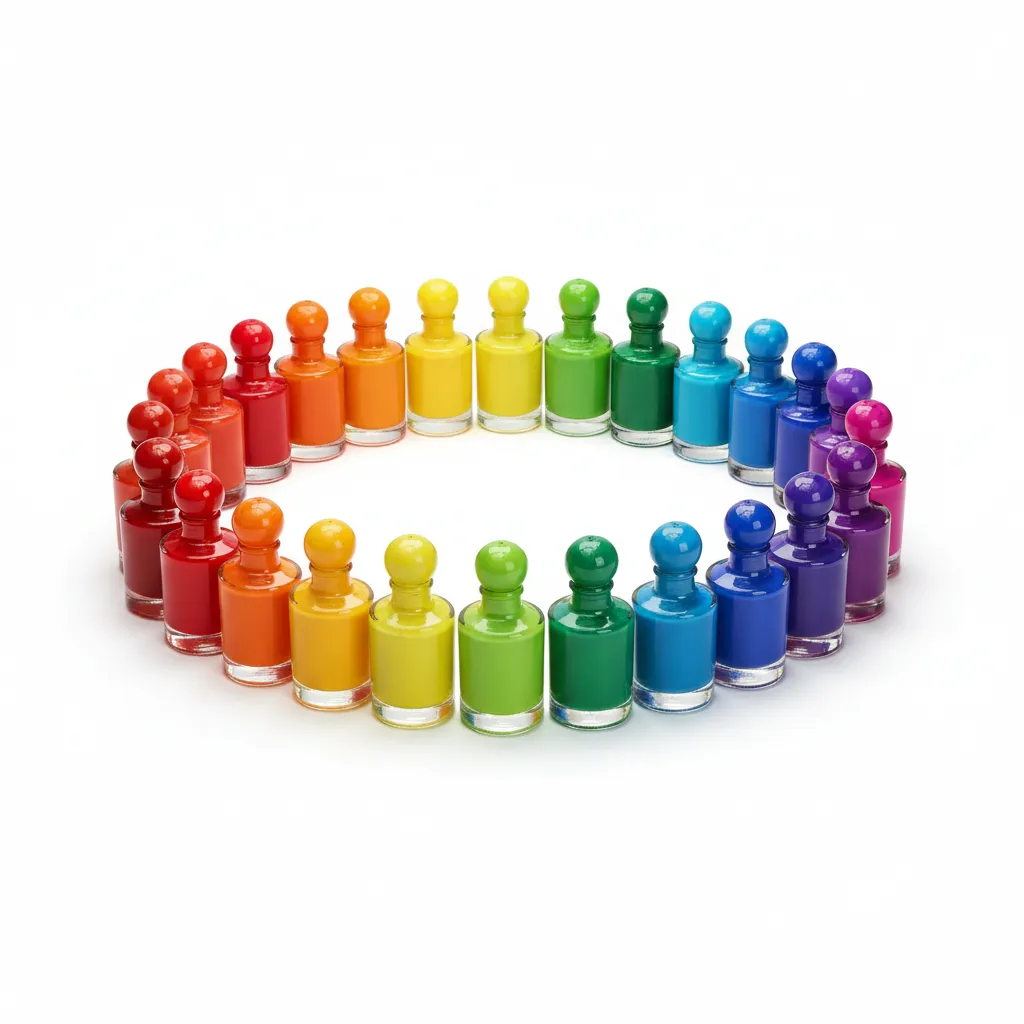
A client sits down and says, “I want something that looks good.” No reference photo, no Pinterest board, no specific shade. The techs who handle this well understand color theory. Not in a fine-art-degree way, but in a practical, which-polishes-look-great-together way.
The Color Wheel for Nail Technicians
Every color relationship in nail art starts with the color wheel. It organizes 12 hues into three groups:
Primary colors (red, yellow, blue) cannot be mixed from other colors. They are the foundation.
Secondary colors (orange, green, purple) come from mixing two primaries.
Tertiary colors fill the gaps between primaries and secondaries. These are your red-oranges, blue-greens, and yellow-greens. Most nail polish collections live in this tertiary zone. Understanding the wheel tells you which colors work together and which will clash.
Four Color Relationships That Always Work
Complementary Colors
Complementary colors sit directly opposite each other on the wheel. Red and green. Blue and orange. Yellow and purple. These pairings create maximum contrast, making each color appear more vivid.
In nail art, complementary combos work well for accent nails and bold two-tone designs. A deep navy feature nail against peachy-coral fingers reads as intentional. The key is ratio: use one color as the dominant shade (8 nails) and the complement as the accent (2 nails). Equal amounts compete rather than cooperate.
Analogous Colors
Analogous colors are three neighbors on the wheel. Think red, red-orange, and orange. Or blue, blue-violet, and violet. These combinations feel harmonious because the colors share underlying pigments.
Analogous schemes are ideal for gradient designs, ombre nails, and sets where you want variety without tension. A set that moves from dusty rose through mauve to plum gives the client five different nails that clearly belong together.
Triadic Colors
Triadic colors form an equilateral triangle on the wheel. Red, yellow, and blue. Or orange, green, and purple. Triadic palettes shine in geometric designs and playful seasonal sets. The trick is choosing one dominant color and using the other two sparingly.
Split-Complementary Colors
Instead of going directly opposite on the wheel, split-complementary schemes use the two colors adjacent to the complement. If your base is blue, instead of pairing with orange, you use red-orange and yellow-orange.
This gives you contrast with less intensity. It is one of the easiest schemes to execute well.
How to Match Nail Polish to Skin Tone
How colors interact with a client’s skin is where theory becomes personal. A red that looks stunning on one person can wash out another. The variable is undertone.
Identifying Undertones
Skin undertones fall into three categories: warm (golden, peachy, olive), cool (pink, blue, reddish), and neutral (a mix of both). Three quick methods to identify them:
The vein test. Look at the veins on the inner wrist. Green-tinted veins suggest warm undertones. Blue or purple veins suggest cool. If you see both, the client is likely neutral.
The jewelry test. Gold jewelry flatters warm undertones. Silver looks better on cool. If both work equally well, the client is neutral.
The makeup shortcut. Look at the lipstick the client already wears. People gravitate toward flattering colors instinctively. Coral lipstick usually means warm. Berry usually means cool.
Color Recommendations by Undertone
Warm undertones pair well with earthy reds, corals, warm pinks, terracotta, olive greens, and shades with golden or yellow bases. Peach, apricot, and warm nudes make the hands look healthy.
Cool undertones pair well with blue-based reds, berry tones, plum, lavender, icy pink, emerald green, and shades with a blue or pink base. Cherry red and wine are reliable choices.
Neutral undertones have the widest range. Dusty rose, mauve, soft pinks, true reds, and classic nudes are particularly flattering. Neutral clients are your easiest consultations.
Correcting with Undertone Awareness
When a client says a color “looks off” but cannot explain why, the issue is almost always an undertone mismatch. A warm-toned client in a cool-based pink will find the polish makes their hands look sallow. Swapping to a warm pink at the same depth fixes it instantly.
This matters most with nude polishes. A nude that matches one client perfectly will look gray or ashy on a different undertone. Stock nudes in warm, cool, and neutral versions.
How to Mix Custom Nail Polish Colors
Custom mixing is where color theory becomes a hands-on skill. The principles apply whether you work with gel polish, regular lacquer, or acrylic powders.
The Basics
Start with small amounts. You can always add more pigment, but you cannot take it away. Use a clean mixing palette or an empty polish bottle for larger batches.
To lighten a color: add white. This creates a tint. A drop of white in a red gives you pink. More white gives you pastel pink.
To deepen a color: add black sparingly. Black is powerful. Start with the smallest amount possible.
To warm a color: add a tiny amount of true yellow or red. A blue-green that needs warming becomes more yellow-green with a touch of yellow.
To cool a color: add a small amount of true blue. A warm red becomes a cooler, wine-like red with a hint of blue.
Practical Mixing Tips
Document every custom mix. Write down the ratios the moment you get a shade right. “3 drops coral + 1 drop white + half drop yellow” takes five seconds to note and saves you from recreating it from memory later.
Stick to the same brand when mixing. Different formulas have different viscosities and finishes. Mixing across brands leads to inconsistent texture and curing problems with gel products.
Create sample tips. Cure or dry your custom mixes on clear practice tips and label them. When a client wants to repeat a color six weeks later, pull the reference tip and remix with confidence.
Mix in natural light when possible. Salon lighting shifts how colors appear. A shade that looks perfect under warm LED panels can read completely different in daylight.
Trending Color Combinations
These pairings keep showing up because they follow color theory principles, even when the people choosing them do not realize it.
Navy and blush pink. A cool-warm complementary pairing with enough contrast to feel modern without being loud.
Terracotta and sage green. Analogous earth tones that feel organic and sophisticated. Popular for fall and spring alike.
Lavender and butter yellow. A soft split-complementary pair that works across skin tones because both sit in the pastel range.
Chocolate brown and baby blue. A warm-cool contrast that borrows from complementary theory while staying wearable.
Burgundy and gold. A classic analogous-adjacent combo that translates across nail art styles, from minimalist accents to full glitter features.
Apply Color Theory at Your Nail Station
Get a physical color wheel from any art supply store and keep it at your station. When a client cannot decide, walk through the relationships. It positions you as someone who understands why things look good, not just someone applying product.
Build a reference library of sample tips organized by color family and undertone. Over time, this becomes your most valuable consultation tool, turning “I want something that looks good” into a two-minute conversation that ends with a specific, flattering choice.
For inspiration on which color combinations are trending right now, check out our nail art trends guide. And to level up the consultation process, see how a client consultation form can capture color preferences before the appointment even starts.