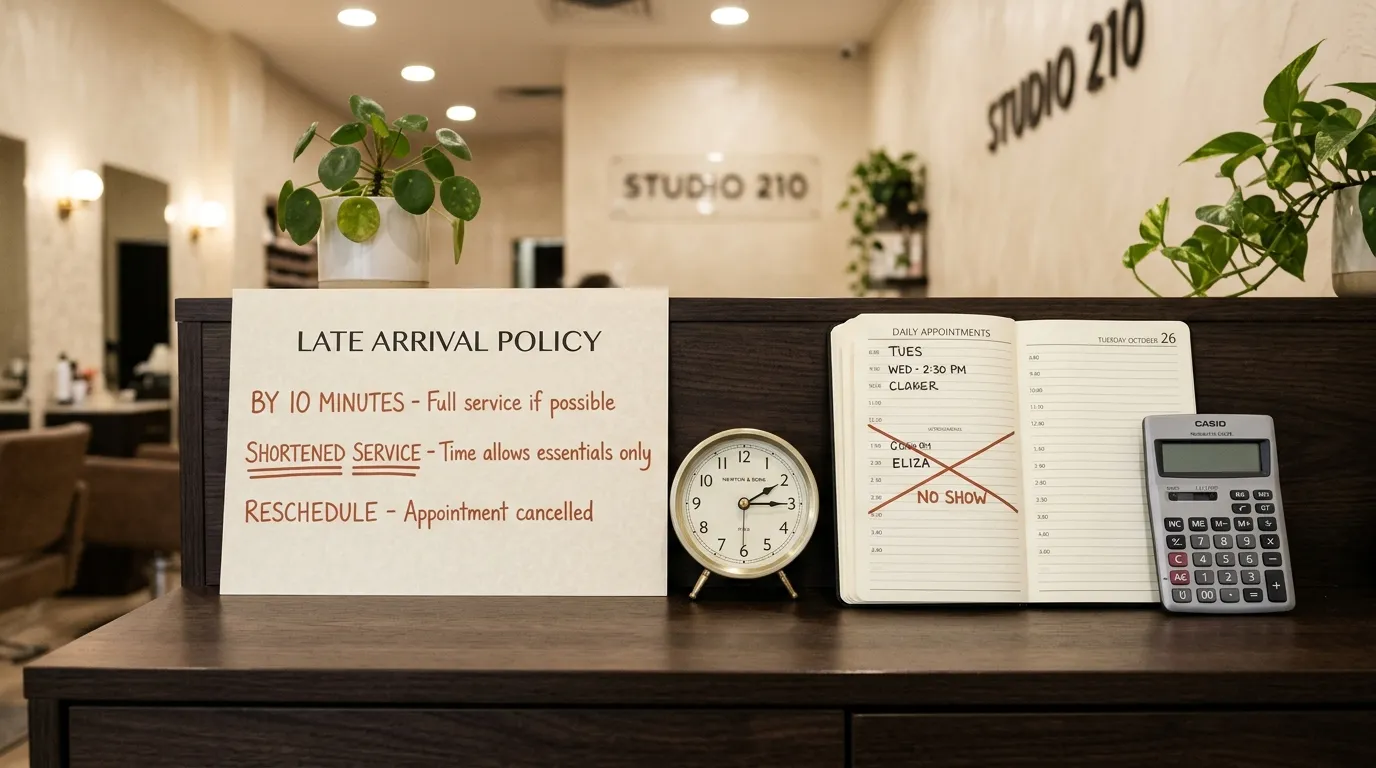
Every salon has a client who treats her appointment time as a suggestion, and most salons respond the same way: a shrug, a squeeze-in, and an afternoon quietly set on fire. The shrug feels generous in the moment. It puts the next four clients behind and teaches the late one that the clock at your desk is decorative.
Forty-five percent of salon clients name waiting for their appointment as their single biggest frustration, according to Zenoti’s 2024 consumer survey. The on-time client in your lobby at 2:15, waiting on a 2:00 booking, is living that statistic and deciding whether to rebook while she sits there.
A nail salon late arrival policy is unglamorous by design: three decisions, made once, written down, applied the same way every time.
A Salon Late Arrival Policy Is Three Decisions
Decision one: absorb. Set the grace window at 10 minutes and let the service run complete inside it. Booksy’s late-arrival framework for nail salons treats 10 minutes as the working standard for high-volume shops, and the arithmetic holds: a client 12 minutes late for a 45-minute gel fill has burned nearly 30 percent of her billable block before the first file moves. The window exists so the desk never has to adjudicate a two-minute delay.
Decision two: shorten. Past the window, the service shrinks by the overrun, and the removal order is the policy. Extras come off first: the art tier, the paraffin, the hand massage. The prep sequence never does. Gel cure times are fixed physics, and the e-file cuticle work, dehydration, and priming that keep a set from lifting cannot be rushed, which is why compressed gel services come back as free repairs. When the minutes gone would force skipped prep, decision two is over.
Pricing follows scope. If only the add-ons came off, the booked price stands; if essential work came off, the price adjusts to what was delivered. Full freight for a stripped service converts one late arrival into a one-star review.
Decision three: reschedule. When remaining time cannot deliver the service, the appointment moves and your disclosed terms apply. This is where late fees live or die. They were agreed to at booking or they do not exist; the FTC’s fee-disclosure guidance requires mandatory charges to be clear and conspicuous before purchase, and a $25 fee invented at checkout loses the dispute and the client in one conversation. Where salons charge, the common amount is 50 percent of the service price, per one 2026 policy guide, applied to the card or deposit the client already accepted. Waive it on a first offense. Emergencies and disability-related accommodations get handled case by case, as ADA Title III expects of public-facing businesses.
Two pieces of math hold this up. A turned-away slot costs the same as a no-show, 1.3 to 1.5 times the ticket once labor and the empty chair are counted. And the grace window only works on top of buffer time built into the book; against a zero-gap schedule, ten minutes of grace is ten minutes taken from the next client.
The Client Late for Nail Appointment After Nail Appointment
The chronic case breaks the system in a softer way. She is pleasant, apologetic, and eight minutes late every single visit, which is why the floor lets it slide for years. The scripts for difficult clients aim at rudeness, and rudeness has never been her problem.
Handle her in three steps, in order.
Document without labels: every arrival in the notes, date, minutes late, outcome. “May 4, 19 minutes late, shortened service” is useful. “Difficult client” is decoration.
Move her slot before you lecture her. A client late by habit books into the last chair of the day, where her overrun damages the closing time and nothing else. It costs nothing and contains the damage immediately.
Then talk before the next booking, privately, with the log open:
“I want to keep you on the schedule, so I want to be straight with you. Your last three visits started 12 to 19 minutes late, and each one shortened a service or pushed another client. Starting with your next appointment, the booking is prepaid, and the service ends at the clock, with whatever fits finished inside it. If that does not work for you, I would rather say it plainly than surprise you at the desk.”
No drama in it, no apology, and no threat beyond the consequence already in writing. If she is late to the prepaid slot, the terms execute. If she runs late once more after that, the book closes with one sentence: “I am not able to keep rebooking appointments that cannot start on time.”
Every minute donated to the late client comes out of the on-time one, and the on-time client is the one the business runs on.