Fix it free and she stays for life. That rule runs unposted in most salons: the popped tip at day nine gets soaked, reshaped, and billed at zero, because charging feels like a bet on the client leaving. The books disagree. A nail salon redo policy with a fix window and a posted fee schedule keeps more clients than unlimited free fixes, and it costs less every week it runs. Four parts do the work: the window, the per-service rules, the paper trail, the fee tiers.
Fixing Every Nail Free Feels Like Loyalty
A regular texts a photo of a lifted corner on day four, books a patch-up between clients, pays nothing. The repair cost fifteen minutes, so the salon absorbs it and files the absorption under marketing. Nothing on the month-end report ever shows a repair line at $0.
Why the Free-Fix Habit Survives
The habit starts small and stays invisible. A single-nail fix is the cheapest favor on the menu, and no receipt exists for work never charged; the same absorption lets free soak-offs run unbilled, which the removal-fee math costs out at $17,000 a year. Fear finishes the job: the tech who considers a fee hears the sentence “but you fixed it free last time.” Without a posted window, every repair becomes a fresh negotiation, and the negotiation resolves toward free because free is faster than arguing.
What the Numbers Show
Start with the wage. The median manicurist earns $17.19 an hour per O*NET’s 2025 data. A single-nail repair runs 10 to 20 minutes of chair time. Call it 15. On a chair earning $53.30 an hour, the site’s standing benchmark from a $40 gel set in 45 minutes, each unbilled repair displaces $13.30 of capacity. One unbilled repair a week per chair is $640 a year. A six-chair salon absorbs roughly $3,800 annually on work nobody prices.
The industry has already voted on the window. Bellacures posts 3 days for regular polish, 7 for power polish, 10 for gel. Bnails guarantees enhancements, gel polish, and dip for 7 days. Ambiance Nail Spa guarantees 7 days across gel, dip, and acrylics, guarantees nothing on regular polish, and bills repairs in full once the window closes. Nobody posts 30. Application faults surface fast: lifting, bubbling, and a tip that failed to bond show up in the first week or they were never the application’s fault. Outside the window the market already prices the work: Boulevard’s 2026 benchmarks list acrylic repair at $5 to $15 per nail, beside infills at $20 to $45.
Chemistry caps any guarantee: gel worn past four weeks risks moisture trapped under lifting edges, which GelCare’s wear guidance flags as a hygiene problem. A chip at week three is end-of-life wear. A chip at day three is an application fault. The window exists to tell those two apart.
The Free Nail Fix Window: Where a Salon Repair Policy Starts
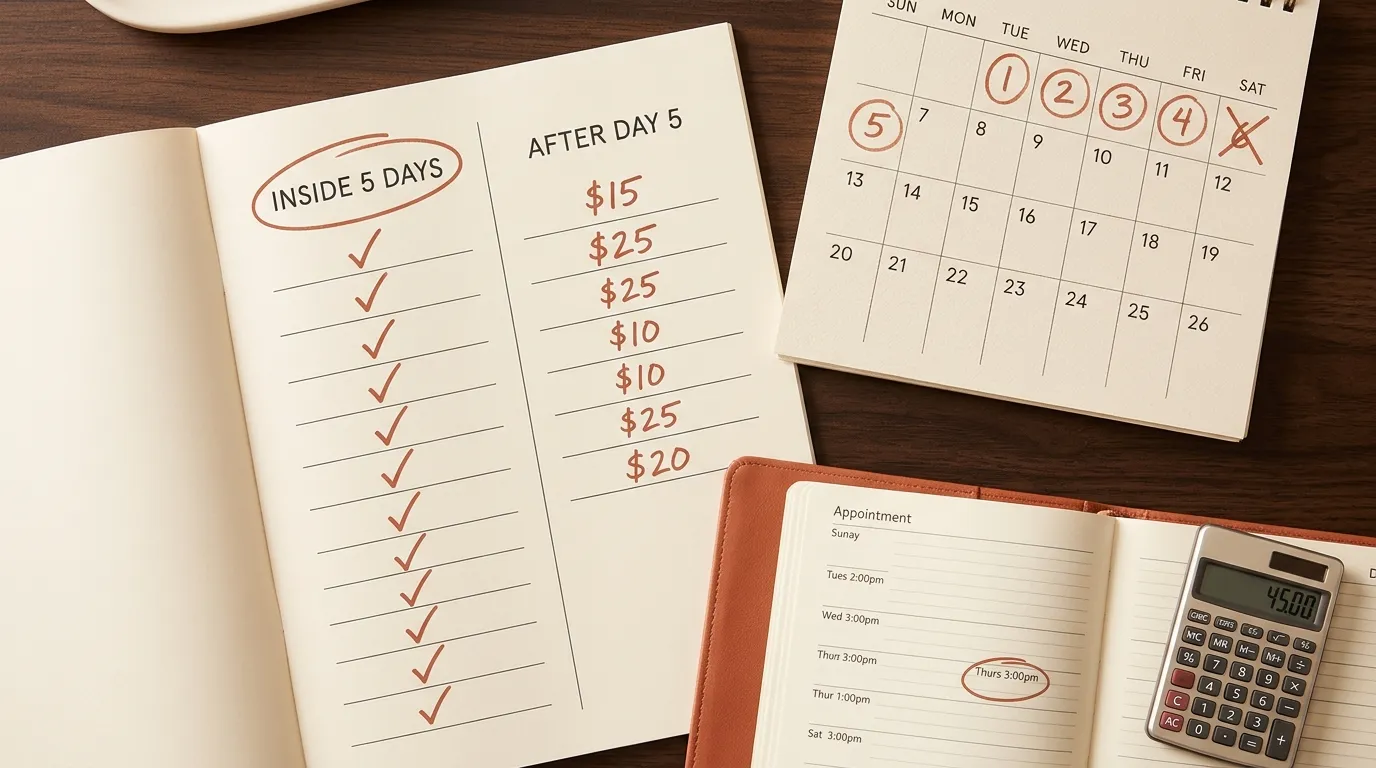
Set it at five days for gel, dip, Gel-X, and acrylic, and three days for regular polish. The boundary is the point: five days catches the failures the salon owns and excludes the breakage the client’s life causes. A set that lifts on day two had a prep or cure problem; a tip that snaps on day twelve met a gym dumbbell. Publish the deadline at checkout, in the same breath as the price.
When to Redo a Set for Free, Service by Service
| Service | Free inside the window | Billable outside it |
|---|---|---|
| Regular polish | 72-hour touch-up at most; many salons guarantee nothing | Polish change fee |
| Gel manicure | Lifting or chipping at the application edge, same color | Per-nail repair fee; week-3 wear is end-of-life |
| Gel-X | A popped or lifted tip, re-tipped with a fresh tip | Impact breakage; a failed set after the window bills as a new set |
| Acrylic | A lift or crack, fixed free at the chair | Breaks at week 2 to 3 are wear: bill the repair, book the fill |
Two clauses hold the table together. The redo matches the original: same color, same shape, same length, Bnails’ wording and worth copying, because “redo” otherwise becomes a free redesign. And four lifted nails at day three mean the prep failed: the client leaves with a full free redo.
Nail Repair Fee Tiers and the Paper Trail
Set the tiers once and post them:
- Single nail, outside the window: $10. Boulevard’s band runs $5 to $15 a nail, and fifteen minutes at $10 earns $40 an hour: above the $17.19 median, below the chair’s $53.30.
- Two to four nails: $5 each, capped at $20. The per-nail rate rewards the client who calls fast.
- Full redo outside the window: the fill price. A set failed by wear bills like a fill, $20 to $45 on acrylic, rather than like a new set.
Inside the window, all of it is free, no exceptions and no manager sign-off.
Write the paper trail at appointment time, both ends. Photograph the finished set at the chair and file it with the client’s consultation form; log the date and the tech in the booking notes. Ambiance’s policy asks out-of-window clients to recall the original salon, the day, and the technician. A thirty-second photo answers all three before the questions exist.
What to Say to the Client Who Expects Free Fixes Forever
Scripts work best delivered as policy, flat and unapologetic.
To the in-window client: “That lift at day two is ours. Come in Wednesday and it’s on us, same color.”
To the out-of-window break: “At two weeks, a break is wear. A single-nail repair is $10 and takes fifteen minutes.”
To the client who expects unlimited: “Every set leaves here with a five-day guarantee, and it’s posted at the desk. Inside five days, we fix anything, free. After that, repairs run ten dollars a nail.” If she pushes, do not defend and do not discount; the difficult-client scripts handle the escalation. The fee is identical for the regular of six years and the walk-in of six minutes.
Enforcement rides the same rails as the deposit system: the booking notes that trigger a deposit requirement also flag a client on her third out-of-window repair, and that pattern starts a conversation about aftercare or product choice.
A Warranty With Edges
The redo policy replaces a favor with a warranty, and a warranty has edges: fix what the salon owned, bill what the client’s life did, and say both out loud. Loyalty survives a $10 repair fee. It does not survive a shop where the price of a fix depends on who is asking.