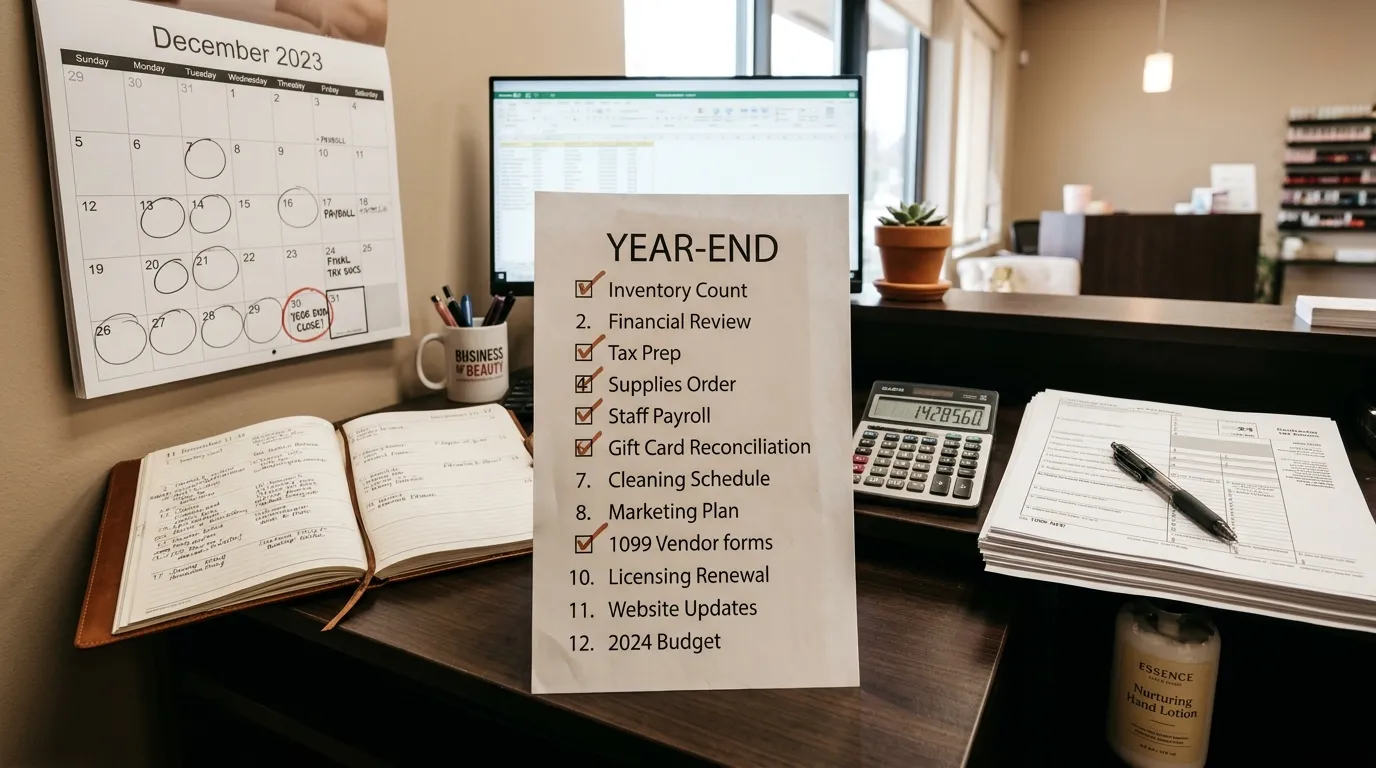
December closes three books at once: the tax year, the supply shelf, and the software bill. Miss the first and the penalties are real. Miss the other two and 2027 starts with expired monomer, zombie subscriptions, and a price list set from memory instead of math. A nail salon year-end checklist turns all three into one week of desk work, most of it done between clients.
Salon 1099 Deadline
January 31 is the due date on paper, but the work happens now. Every technician on booth rent or commission-as-contractor paid $600 or more in 2026 needs a 1099-NEC, and when January 31 lands on a weekend the due date rolls to the next business day, which makes February 1, 2027 the real filing date for the 2026 tax year, per the IRS general calendar for key business deadlines. Employees never get 1099s: W-2s for staff are due to the Social Security Administration on the same schedule. A booth renter’s rent receipts are your income, not a 1099 event; the 1099-NEC applies to services.
The December task is the W-9 chase, because a missing taxpayer ID is the thing that actually trips filers in January. Any vendor paid $600 or more without a W-9 on file needs one, and the IRS W-9 instructions set the sequence: collect the form, make the request in writing, and if it never comes, backup withholding at 24 percent applies to those payments. A stamped request in December beats 24 percent held back in February. Collect through the last week of the month, file the completed forms with the pay totals, and note which contractors left mid-year: each gets a 1099 if the annual total crosses $600.
Payroll Paperwork, Before the Champagne
Reconcile the last pay run of 2026 against its returns: Form 941 for the quarter, Form 940 for FUTA, and year-to-date W-2 wages that will carry into January boxes. The Social Security wage base rises to $184,500 for 2026, per the rate table in IRS Publication 15-A, so a high-earning tech or manager may cross the cutoff in the fall, and the 6.2 percent employee share simply stops on wages above it. Employees from 2026 who quit in October still need a correct W-2 address waiting in January, which is why the December file check matters.
Contractors complicate one line: tips. Most techs receive tips directly, report them on their own returns, and neither you nor payroll withholds on them. Employee techs who receive tips through reported payroll face different mechanics, so confirm which pay structure each chair actually runs before January forces the question. For a fuller walkthrough, the nail salon bookkeeping guide covers the categories these forms drop into.
Salon Inventory Count
A salon inventory count in the first week of December, before holiday traffic strips the shelves, lets you compare counted product against purchase records and against last year’s count. The gap is shrinkage, and it prices directly: the product-costs guide uses the site’s standing $5 per-service average, so a 20-service day leaks $100 of product at a 20 percent waste rate, roughly $7,200 a year on 360 service days. December’s count is the only one that feeds a tax number too. The IRS does not demand a December 31 snapshot: Publication 538 permits a physical count within a reasonable period around January 31, or a range including January 1. Take the allowance. Count during the holiday lull, when shelves are fuller, and date the sheet. An inflated figure understates costs and flatters profit this year, then reverses next year when the correct count lands.
Count the products the shelf-life math disqualifies at the same time. Opened monomer and polish top coats give you about a year, nail adhesives expire a year after opening and are the items most often bought in bulk, polish remover is the long timer at roughly five years, and unopened lotions hold one to two years, all from NAILS Magazine’s product shelf-life chart. December is when an expired-product purge is easiest, because no client sits in the chair while you discard, and the disposal rules for volatile, reactive, or EPA-flagged products need the attention a holiday week rarely gives. Write off the purge in the same entry as the count, and photograph shelves by station so next year’s comparison starts with proof neither of you can argue with.
The Subscription Audit That Ends Zombie Software
Booking platforms, card readers, payroll software, and the marketing tools signed up for in a busy April renew on annual cycles that cluster in December, and the audit is a blood draw: list every recurring software charge on this year’s credit card and bank statements, then check last login. Sitting across from an owner counts as a login. The SaaS-waste analysis puts the average at $2,000 per employee per year in unused seats, per Torii’s research, and assigning an owner and a renewal date to every subscription is the standard remedy, the practice this audit formalizes. A $350 monthly booking and payment stack is $4,200 a year; cancel November dead weight and the savings compounds into every 2027 month afterward.
The Three Reports Deciding 2027 Prices
- Service revenue by technician. Pull it from the booking system, because the mix of gel, structured gel, and pedicure per tech is what a price increase multiplies, not the printed menu. December’s pre-holiday mix is unusually full-complexity, so it shows what demand actually buys at current prices.
- Product cost per service, recounted. The December count feeds this denominator: divided over 2026 service volume, it is the input the salon can actually control, and it is the honest floor a price rise must cover.
- Net profit by month. The year’s graph shows which months fund which choices, and it is the report that tells you whether January slow-season discounts are a marketing expense or a margin leak.
Take the three numbers into pricing season with the raising-prices data in hand: a 10 percent bump historically sheds about 10 percent of clients and often nearer one percent of revenue, the myth-busting this site has already run. Land notices at least thirty days before a February take-effect, and confirm professional salon insurance limits while policies are open, since higher revenue changes what coverage should carry.
The 12-Tick Closing Table
| Tick | Task | Done by |
|---|---|---|
| 1 | Chase W-9s from every $600-plus contractor and vendor | Dec 15 |
| 2 | Reconcile final pay run against 941 and 940 | Dec 20 |
| 3 | Pull gift card liability for 2026 sales versus redemptions | Dec 24 |
| 4 | Full salon inventory count and shrinkage comparison | Dec 27 |
| 5 | Expired-product purge with write-off entry | Dec 27 |
| 6 | Depreciation list to the accountant (new chairs, lamps) | Dec 28 |
| 7 | Subscription audit and cancellations before renewals | Dec 28 |
| 8 | Clean the 1099 contact sheet (names, TINs, addresses) | Dec 29 |
| 9 | Three reports: revenue mix, product cost, monthly profit | Dec 30 |
| 10 | Rough 2027 price ladder against those numbers | Dec 30 |
| 11 | Confirm Q4 estimated payment and payroll bonuses | Jan 10 |
| 12 | File 1099-NECs and W-2s | Jan 31 |
A week on the checklist between clients produces payroll-ready books, a defensible inventory number, a software bill that pays only for tools in use, and a price list priced from December’s invoice data instead of January’s guess. Done right, the salon walks into 2027 with its year already closed.