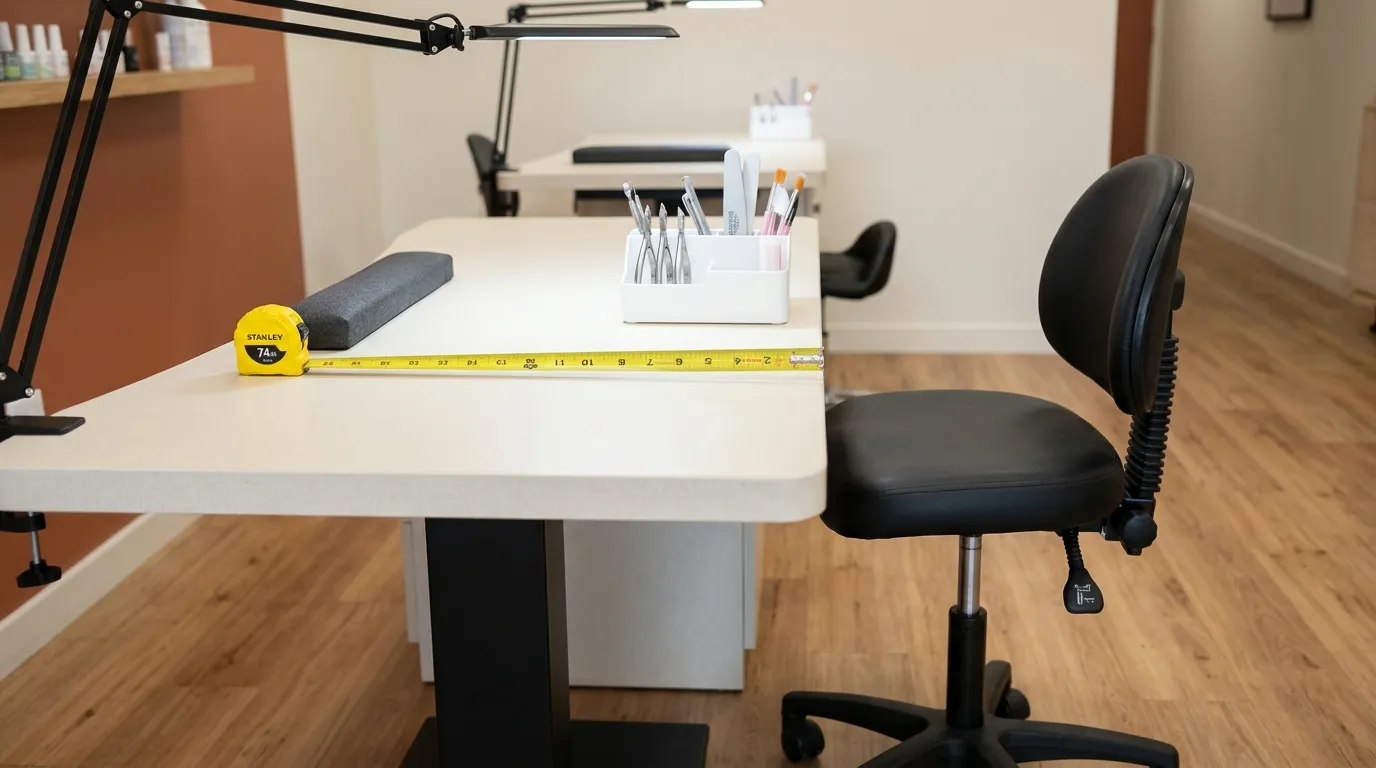
Nail technicians carry 15 times the shoulder problem rate of office workers, 5 times the neck rate, and 3.6 times the wrist and hand rate, according to a study in Occupational Medicine that compared salon techs against desk-based controls. Lower back complaints ran 3.5 times the control group. OSHA defines ergonomics as the study of the work environment to make work more comfortable and efficient, and at the nail table that study comes down to four specs: table height, wrist angle, client position, and the reach radius on the table. None of them costs more than a few hundred dollars. All of them decide how long the career lasts, and the burnout math this site has already run says most techs exit early.
What the Injury Data Says
Federal survey data backs the clinical numbers. In O*NET’s 2025 work-context data, 62 percent of manicurists report making repetitive motions continually or almost continually, and 66 percent spend the day handling tools and controls at the same near-constant rate. A job built from small repeated movements performed in one fixed posture is the exact recipe for swollen tendons and compressed nerves.
The financial exposure is just as measurable. The median manicurist earns $17.19 an hour, $35,760 a year, per the same O*NET and BLS data, and the BLS projects 21,900 openings a year through 2035, driven by growth and by workers leaving the occupation. Run the arithmetic on one exit: a career cut short by five years at the median wage is $178,800 of income the tech never collects. A complete ergonomic station with table, chair, lamp, and footrest prices out at $300 to $500 in the 2026 setup guides. The ratio between those two numbers is the whole business case.
Where Nail Tech Wrist Pain Actually Starts
The wrist is the most overworked joint at the table. Filing, drilling, and polish work all invite the wrist to bend, and a bent wrist under repetitive load is how tendons swell and the carpal tunnel narrows. The Nail Manufacturers Council’s ergonomic basics, the handout OSHA points techs toward, compress the fix into one line: keep the wrist straight, bend the elbow and shoulder instead, and move the client’s hand toward you rather than reaching to it.
Vibration belongs in the same ledger. The NMC warns against running an e-file for extended stretches without rest breaks, because even low-level vibration contributes to injury over a full book of clients. The pressure, speed, and bit habits that keep the handpiece from fighting back live in the e-file safety guide.
The last wrist hazard is furniture. OSHA’s nail salon guidance names resting wrists and forearms on hard or sharp table edges as a primary cause of injury, and the fix costs nothing: a foam pad or a rolled towel over the edge.
Manicure Table Height: The Elbow Rule
Table height decides whether the straight-wrist rule is even possible. The method takes one minute: sit in your work chair with feet flat and shoulders relaxed, then measure from the floor to the underside of your bent elbow. The tabletop should sit within about 1 to 2 inches of that number. For most techs that lands the manicure table height between 28 and 30 inches, with shorter techs better served by adjustable tables dropped to 26 to 28 and taller techs at 30 to 32.
A table set wrong shows up in the shoulders first. Too high and the shoulders hike toward the ears; too low and the neck cranes forward all day. Shared stations should buy adjustable, because a fixed table built for a 5’4” tech fails a 5’10” one, and turnover guarantees the team changes.
Legroom is the measurement most stations fail. Aim for 24 inches of clear space, wide and deep, under the table, which usually means a pedestal base instead of side cabinets. Sit close enough that your stomach nearly touches the edge; reaching forward from a distance rounds the back before the first file touches nail.
Nail Technician Back Pain Comes From the Lean
The back fails the same way the wrist does, by degrees, and the NMC sets the degrees: no more than 30 degrees of forward lean at the back, no more than 45 at the neck. Watch any full book of back-to-back clients and count how often both limits fall. The lean comes from three setup failures: a chair set too far from the table, a table below the elbows, and lighting too dim to show the work without leaning in.
The chair carries half the ergonomic load, per the 2026 equipment guide, and its spec reads like this: thighs parallel to the floor, feet flat, footrest if the feet dangle, and a backrest with lumbar support. The NMC adds that the seat should run at least an inch wider than the hips on each side so no pressure point builds up behind the knees.
Pedicures carry their own back bill. Keep the client’s foot directly in front of you, close to your body, raised to just above elbow level, and lift nothing heavier than 15 pounds using the legs instead of the back. Those numbers come from the same NMC handout, and they cost zero dollars to apply.
Client Positioning Closes the Gap
A fixed-height table is only ergonomic if the client adjusts, and the client’s chair is the cheapest adjustable equipment in the building. OSHA is explicit about the mechanism: raise and position the client’s hand or foot so the tech stops bending over to meet it. Operationally, the client’s hand should rest at roughly your sternum height on a cushioned armrest, in a chair that reclines or adjusts so the work comes to you instead of you going to the work.
The NMC adds the habit that saves a neck: move the client’s hand rather than tilting your head. Every degree of head tilt skipped is a degree the cervical spine keeps. A salon running fixed dining chairs at the mani tables should replace those first, because the swap converts a reaching job back into a sitting job within one afternoon.
Tool Layout and the 12-Inch Radius
The NMC reach rule: nothing used on every client sits more than 12 inches away, forearms parallel to the floor, task and tools directly in front, no favoring one side. Most stations fail this quietly. Files live in a drawer, polish racks hang off to the side, the lamp arm needs a wrestle to move, and each extra reach is a small twist repeated hundreds of times per day.
Fix the layout in one pass. A caddy on the table holds the tools every service touches. A rolling trolley parked beside the chair holds everything else. The ventilation code pushes the same geometry, because it requires exhaust inlets within 12 inches of the point of application, the same radius the tools want; the ventilation requirements guide covers the 50 CFM source-capture spec. One station layout satisfies the code and the reach rule at the same time.
Lighting finishes the layout. OSHA lists adjusting light levels so you can see the work without bending over as an ergonomic control, and the specs live in the station lighting guide: 800 to 1,500 lux at the task surface, CRI 90 or better, with the lamp head roughly 30 centimeters from the nail. A magnifying lamp earns its footprint twice on this list, once for color accuracy and once because it removes the reason to lean in at all.
The Micro-Habits That Buy Career Years
The setup removes the load; the habits give the tissue time to recover. The NMC routine takes about 90 seconds between clients: rotate the wrists, open and stretch the fingers, raise the arms, stretch the neck and back. Hand-washing between clients is already mandatory, and the NMC counts it as a built-in break, so anchor the stretch to it. Two resets a day cost three minutes of chair time, about 90 cents at the median wage, against a five-year career bill of $178,800.
Two habits close the loop. Change position and task when the schedule allows, because holding any single posture all day is its own hazard, in OSHA’s wording. And treat pain as data: the NMC’s closing instruction is to stop ignoring discomfort and see a medical professional if it persists, because tendon damage caught at the ache stage costs weeks and caught at the surgery stage costs the chair.
The Ergonomics Checklist
| Spec | Number | Source |
|---|---|---|
| Table height | Within 1-2 inches of seated elbow height; most techs 28-30 inches | 2026 setup guide |
| Reach radius | 12 inches maximum, tools directly in front | NMC |
| Forward lean | 30 degrees at the back, 45 at the neck | NMC |
| Client’s hand | Sternum height, on a cushioned rest | OSHA, NMC |
| Legroom | 24 inches clear, wide and deep | 2026 setup guide |
| Lift limit | 15 pounds, legs not back | NMC |
A $400 station set against a $178,800 career is the clearest trade in the salon, and it is the only purchase that keeps paying out on every client, every day, for decades.