Most nail techs set their prices by looking at what the salon down the street charges and matching it. That approach leaves money on the table. If your costs are different, your experience is different, or your skill level is different, copying someone else’s menu is a recipe for burnout and thin margins.
Well-managed nail salons operate at 15% to 45% net profit margins. Poorly priced ones scrape by at 5% to 10%. The difference almost always comes down to whether the owner ran the numbers or guessed.
Here is how to build a pricing structure based on real costs, real market data, and real psychology.
Step 1: Calculate Your True Cost Per Service
Every service you perform has a cost floor. Drop below it and you lose money regardless of volume. Your cost per service breaks into three buckets:
Product costs. Direct supplies consumed during the service. For a basic manicure, that is roughly $2 to $5 in polish, files, cotton, and disposables. A full acrylic set runs $3 to $7 in product alone. Gel applications fall in between at $2 to $5 per client.
Labor costs. The median hourly wage for nail technicians in the U.S. was $16.66 in May 2024, with the top 25% earning over $18 per hour. If a gel manicure takes 45 minutes, labor alone costs you $12.50 at median wage. Add payroll taxes (roughly 7.65% for the employer share of FICA) and that climbs to $13.45.
Overhead allocation. Rent, utilities, insurance, software, marketing, and equipment depreciation. A typical salon allocates 15% to 20% of revenue to rent and utilities and another 5% to 10% to admin and marketing. The simplest way to assign overhead per service: divide your total monthly overhead by the number of services you perform in a month.
The formula:
Total Cost Per Service = Product Cost + Labor Cost + (Monthly Overhead / Monthly Service Count)
If your monthly overhead is $6,000 and you perform 400 services, that is $15 per service in overhead. A gel manicure using $4 in product and $13.45 in labor has a true cost of $32.45. Charge $35 for that service and you are making $2.55 in profit. Charge $50 and you are making $17.55.
Step 2: Research Local Nail Salon Prices
National averages give you a reference point. In 2024, a basic manicure runs $15 to $25, a gel manicure $25 to $45, a basic pedicure $20 to $40, and a full set of acrylics $35 to $80. A combined mani-pedi typically falls between $40 and $75.
Those ranges are wide for a reason. Geography, clientele, and salon positioning all shift where you land.
How to gather local data:
- Visit 8 to 10 competitor websites or Google listings in your area. Record their prices for your five most popular services.
- Note what is included at each price point. A $30 gel manicure with a hand massage and hot towel is a different product than a $30 gel manicure without extras.
- Identify where you sit on the spectrum. If you offer a premium experience, cleaner sanitation practices, or higher-end products, you belong in the upper third of local pricing.
Do not anchor to the cheapest competitor. They may be undercharging, operating illegally without proper ventilation or licensing, or subsidizing services with high retail markup. Your job is to find where your quality level sits, then price accordingly.
Step 3: Apply a Healthy Markup
Once you know your cost floor, apply a markup that accounts for profit, reinvestment, and a buffer for slow months.
A starting benchmark: 75% to 100% markup on your total service cost. Quick services like polish changes and express manicures can sit at the lower end (75% to 85%). Complex, labor-intensive services like sculpted acrylics, hand-painted nail art, or structured gel extensions should land at 90% to 100% or higher.
Using the gel manicure example above: a $32.45 cost with a 90% markup lands at $61.65. Round that to $62 or $59 depending on your positioning.
If that number feels high compared to your current prices, that gap is the money you have been leaving behind.
Step 4: Nail Salon Pricing Psychology Tips
How you present prices matters almost as much as the prices themselves.
Charm pricing. Prices ending in 9 outsell round numbers. A study published in the journal Quantitative Marketing and Economics found that charm prices outsold rounded prices by 24%. A $49 gel set feels meaningfully cheaper than $50 to most clients, even though the difference is negligible to your bottom line.
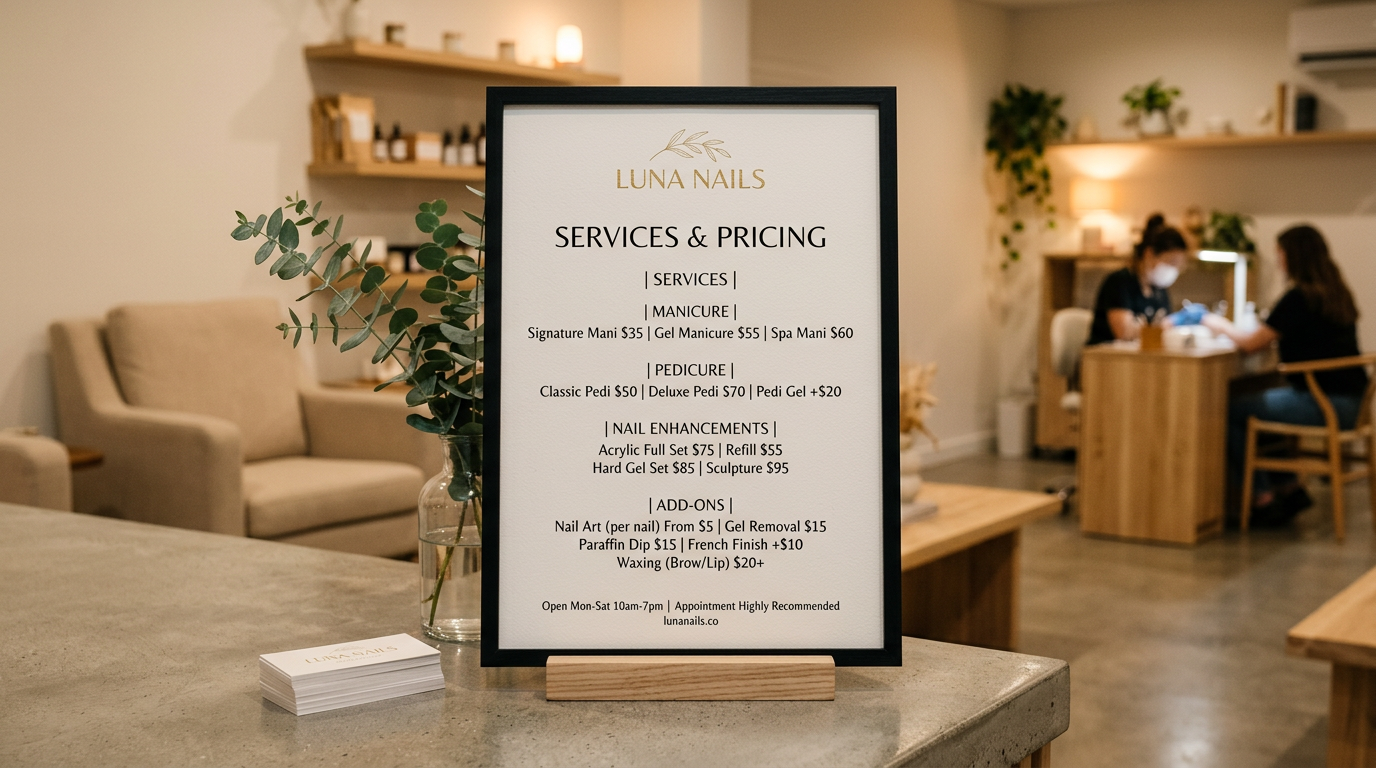
Tiered menus and anchoring. Offer three tiers for your core services: a basic option, a mid-range option, and a premium option. Most clients choose the middle tier. But here is the trick: make the gap between the mid and premium tier small. If your basic mani is $25, your signature mani is $39, and your deluxe mani is $45, the $6 jump from signature to deluxe looks like a bargain. That nudges clients up while boosting your average ticket.
Bundle pricing. Package a manicure and pedicure together at a price that is 10% to 15% less than buying separately. You give clients a perceived deal while guaranteeing a larger transaction per visit. The client who came in for just a pedicure now spends $65 instead of $40.
Remove the dollar sign on printed menus. Research from Cornell’s School of Hotel Administration found that guests spend more when prices are listed as plain numbers (45) rather than with currency symbols ($45.00). Small detail, real impact.
Step 5: When to Raise Your Nail Service Prices
Annual price increases of 3% to 5% are standard in the nail industry and necessary to keep pace with rising supply costs, rent, and wages. If you have not raised prices in over a year, you have effectively given yourself a pay cut.
Raise your prices when:
- Your schedule is consistently booked 85% or more for three months straight. Full books with no room for new clients means demand exceeds your supply. Price is how you balance that equation.
- Supply costs increase. When the cost of gel, acrylic powder, or disposables goes up, pass it through. Your clients understand inflation.
- You complete advanced training or certification. New skills justify new prices. If you invest $2,000 in a nail art certification course, your clients benefit from that expertise and should compensate it.
- You move to a better location or upgrade your space. Higher rent and a better client experience both warrant higher pricing.
How to communicate the increase. Give 30 days notice. A simple sign at the front desk, a line in your booking confirmation emails, and a brief social media post are enough. Do not apologize. Frame it around continued quality: “To maintain the products and experience you love, our prices will update on [date].”
Track the impact using your POS system. Square, GlossGenius, Lutily, or whatever you use can show whether appointment volume dips after an increase. In most cases, you will lose a small number of price-sensitive clients and more than make up the difference in higher revenue per service.
The Bottom Line
Pricing is not about what feels right or what the salon next door charges. It is math. Calculate your costs, research your market, apply a markup that actually generates profit, and revisit annually.
A nail tech earning $16.66 per hour at someone else’s prices is a technician. A nail tech who runs the numbers and charges what the work is worth is a business owner. Know which one you want to be, then set your prices accordingly. If you are just getting started, our guide on starting a nail salon walks through the full financial picture.