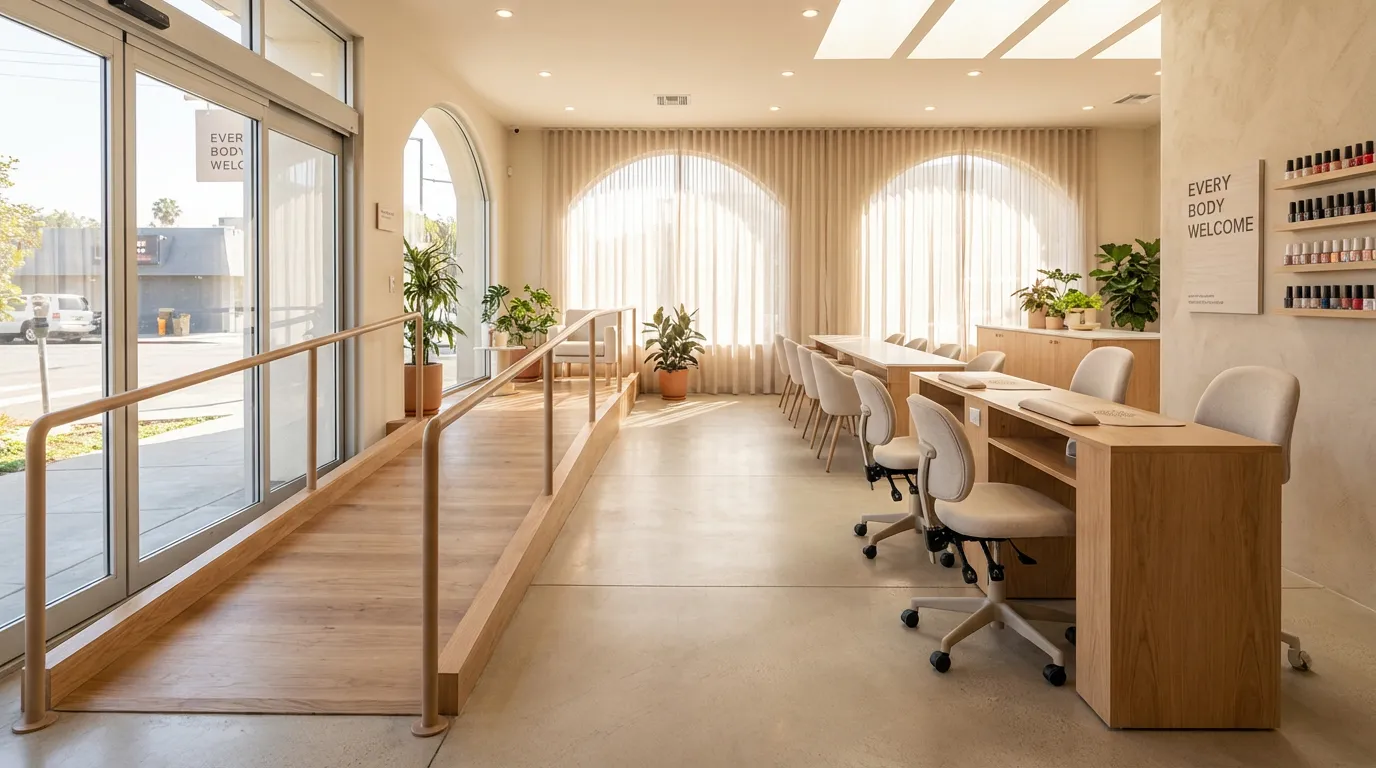
A wheelchair user calls your salon asking about a pedicure. Your front desk hesitates. The entrance has a step. The pedicure chairs sit on a raised platform. The restroom door is 28 inches wide. She thanks you and hangs up. You just lost a client and may have violated federal law.
The Americans with Disabilities Act applies to every nail salon in the United States. It does not matter whether you have five chairs or fifty, whether you own or lease. If you serve the public, you are a place of public accommodation under Title III of the ADA, and you must provide equal access to your services.
ADA Requirements for Nail Salons
The ADA does not demand that every salon undergo a six-figure renovation overnight. The standard for existing buildings is “readily achievable” barrier removal. That means you must remove physical obstacles when doing so is “easily accomplishable and able to be carried out without much difficulty or expense,” as defined by the Department of Justice.
For new construction or major renovations, the bar is higher. You must meet the 2010 ADA Standards for Accessible Design, which cover everything from doorway widths to counter heights to restroom layouts.
Key requirements that apply to salons:
- Entrance accessibility. At least one entrance must be accessible. If there are steps, a ramp with a slope no steeper than 1:12 is required. Handrails are mandatory on both sides of ramps longer than six feet.
- Pathway clearance. Interior routes must be at least 36 inches wide. Where two wheelchairs might need to pass, 60 inches is the standard. This directly affects how you arrange your stations.
- Door requirements. Doors must provide at least 32 inches of clear opening width, be operable with one hand, and require no more than five pounds of force to open.
- Restroom accessibility. At least one restroom must have a 60-inch turning radius, grab bars at 33 to 36 inches from the floor that support 250 pounds, and an accessible sink and toilet layout.
- Parking. If you have a parking lot, you need at least one accessible space per 25 total spaces with an adjacent access aisle connecting to an accessible route.
Common ADA Violations in Nail Salons
Salons tend to hit the same problem areas repeatedly. These are the violations that generate the most ADA complaints and lawsuits in the personal care industry.
Raised Pedicure Platforms
Many salons install pedicure stations on raised platforms for drainage and aesthetics. A client in a wheelchair cannot access a raised platform without a ramp, and most platforms do not have one. According to the U.S. Access Board’s accessible route guidelines, any change in level greater than half an inch requires a ramp or other accessible solution.
Narrow Aisles Between Stations
Salon owners pack in as many stations as possible to maximize revenue. The result is aisles that are 24 to 30 inches wide. A standard wheelchair is about 25 inches wide, leaving zero clearance. The ADA requires 36 inches minimum.
Inaccessible Restrooms
Small salon restrooms are the single most common violation. The door swings inward, the room is too small for a wheelchair to turn, and grab bars were never installed. Fixing this can be as simple as reversing the door swing and adding bars.
Reception Counters That Are Too High
A reception counter at 42 or 44 inches is standard for standing adults. A wheelchair user cannot see over it, sign paperwork on it, or interact with your staff at a reasonable height. The ADA requires at least one section of the counter to be no higher than 36 inches.
No Accessible Entrance
A single step at the front door is the most basic and most fixable barrier. Yet many salons, especially those in older strip malls, have a two- to four-inch step with no ramp.
Adapting Services for Clients with Disabilities
Accessibility is not only about the physical space. It also means adapting how you deliver services so that clients with different abilities can actually receive them.
Wheelchair pedicures. Create a 60-by-60-inch clear floor area where a client can remain in their wheelchair. The technician brings a portable foot basin to the client rather than requiring a transfer to a pedicure chair. Some technicians place the soaking bowl on the wheelchair’s footplate, using towels to protect the chair. NAILS Magazine has documented salons that successfully serve wheelchair users this way.
Clients with limited hand mobility. For clients with arthritis or partial paralysis, offer hand and forearm supports during manicures. Adjust your grip and pressure during hand massage. Ask the client what works rather than assuming.
Visual impairments. Describe colors and nail art options verbally. Offer to hold color swatches close. Provide good lighting at the service area, not just ambient mood lighting.
Hearing impairments. Use written service menus. Confirm choices by pointing to options on a list. Face the client when speaking so they can read your lips if needed.
Cost of ADA Modifications for a Nail Salon
Most accessibility fixes are surprisingly affordable.
| Modification | Typical Cost Range |
|---|---|
| Portable wheelchair ramp (threshold) | $100 to $300 |
| Permanent concrete ramp | $1,000 to $3,500 |
| Grab bar installation (per bar) | $50 to $200 |
| Reversing a door swing | $150 to $400 |
| Lowering a section of reception counter | $300 to $800 |
| Portable pedicure basin setup | $50 to $150 |
| Widening a doorway to 32 inches | $500 to $1,500 |
| Accessible parking signage and striping | $200 to $600 |
Most of these fall well within the “readily achievable” threshold. A portable ramp for a two-inch step costs less than a single day’s revenue. A qualified ADA inspection typically runs $500 to $1,500 and gives you a prioritized list of changes.
The Legal Risk of Noncompliance
ADA lawsuits have been rising steadily, with over 4,000 physical accessibility cases filed in federal courts in recent years. First-time violations carry civil penalties up to $75,000. Repeat violations can reach $150,000. Beyond fines, you may be required to pay the plaintiff’s attorney fees.
If you lease your salon space, do not assume your landlord will handle accessibility. Under the ADA, both landlords and tenants can be held liable for barriers in the leased space.
How to Make Your Nail Salon ADA Compliant
If you have not assessed your salon’s accessibility, start with the free ADA Checklist for Existing Facilities. It walks you through every area of your space with specific measurements and requirements.
Prioritize changes in this order:
- Entrance access. If clients cannot get through the door, nothing else matters.
- Pathway clearance. Rearrange stations to create 36-inch aisles.
- Restroom fixes. Grab bars, door swing, turning space.
- Service adaptations. Train your staff on wheelchair pedicure techniques and communication practices for clients with sensory impairments.
- Counter and signage. Lower a section of your front counter. Add accessible parking signage if applicable.
Making your salon accessible opens your business to the roughly 61 million adults in the United States who live with a disability. Those are clients who actively seek out businesses that welcome them and become loyal regulars when they find one. If you are planning a new build or renovation, our guide on starting a nail salon covers ADA considerations alongside other setup decisions. For more on the insurance side of compliance, see our post on nail salon insurance.