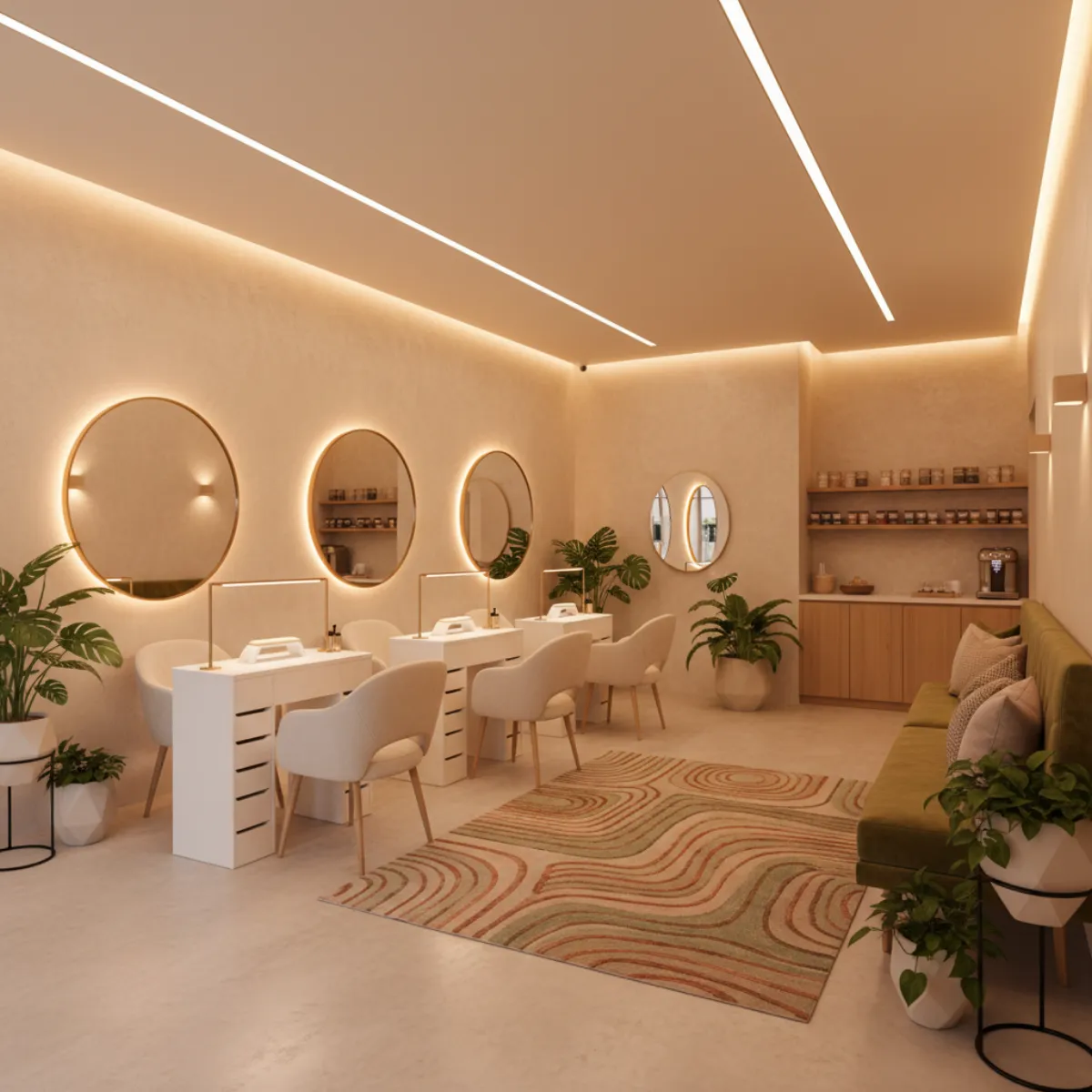
A client forms an opinion about your nail salon within seconds of walking through the door. Before they see the polish wall or meet their tech, they register the sound, the smell, and the temperature. These sensory details shape whether someone feels pampered or eager to leave. Getting ambiance right is not a luxury expense. It is a business decision with measurable returns.
Music Licensing for Nail Salons
If you stream Spotify or Apple Music through your salon speakers, you are likely violating both the platform’s terms of service and federal copyright law. Personal subscriptions are licensed for private use only. Playing music in a commercial space requires public performance licenses from the performing rights organizations (PROs): BMI, ASCAP, and SESAC. Each represents a different catalog, and no single license covers all of them.
Typical annual costs for a small salon:
- ASCAP: starts around $300 per year for a single location, scaling up based on square footage and occupancy
- BMI: ranges from $250 to $400 per year for most small businesses, depending on how music is used
- SESAC: invitation-based and generally requires a separate negotiation, though fees tend to fall in a similar range
You need licenses from all three to play any song without risk. Combined, that is roughly $800 to $1,200 per year for a typical nail salon.
The simpler alternative: commercial music services like Cloud Cover Music, Soundtrack Your Brand, or SiriusXM for Business bundle all licensing into one subscription ($15 to $35/month) with curated stations and scheduling tools. For most salon owners, this is the path of least resistance.
PROs employ field agents who visit businesses, and statutory damages can reach $150,000 per infringed work. A $25/month subscription is cheap insurance.
Best Music for a Nail Salon Playlist
Choosing the right music is more than picking songs you enjoy. Background music directly influences how much clients spend. One retail study found that slow-tempo tracks increased average spending by roughly 40% compared to fast-tempo music, because shoppers lingered longer. Classical or sophisticated background music makes clients perceive a space as more upscale, nudging them toward premium services and retail products.
Some practical guidelines for nail salons:
- Tempo: aim for 60 to 80 BPM for relaxation-focused services (pedicures, spa treatments) and 80 to 110 BPM for the general floor. Avoid anything above 120 BPM unless your brand is explicitly high-energy.
- Lyrics: instrumental tracks or songs with soft vocals work best. Loud or explicit lyrics pull attention away from the service and can make conversations awkward.
- Variety without whiplash: build playlists of 4 to 6 hours to avoid repetition during a shift. Keep the genre consistent. Jumping from jazz to EDM to country signals that nobody is paying attention.
- Time-of-day shifts: play softer, slower music during morning hours when the salon is quieter, and slightly more upbeat tracks during the afternoon rush. Some commercial music services let you schedule different playlists by daypart automatically.
If your salon has distinct zones, consider running separate playlists in each. Calming ambient music in the pedicure room and lightly energetic tracks at the manicure stations create a tailored experience for each service type.
Volume: The Detail Most Salons Get Wrong
Music should sit just below conversational volume. Clients should hear it when nobody is talking, but it should never compete with a normal-voiced conversation between tech and client.
A practical test: speak at your normal volume from a manicure station. If you have to raise your voice even slightly, turn the music down. If you cannot hear it at all, turn it up. The sweet spot is background presence, not foreground distraction.
Invest in a few ceiling-mounted speakers rather than one Bluetooth speaker behind the front desk. Even distribution eliminates dead spots and hot spots.
Scent: Working With (and Against) Nail Salon Chemistry
Acrylic monomer, gel polish, and acetone produce strong chemical odors. Pretending those smells do not exist is not a strategy. Managing them is.
Start with ventilation. A properly sized HVAC system with activated carbon filtration reduces chemical odors at the source. Table-mounted ventilation units at each station pull fumes away from both client and technician.
On top of good airflow, use subtle scenting. Essential oil diffusers with lavender, eucalyptus, or citrus blends work well in waiting areas and pedicure rooms. Avoid heavy fragrances near workstations, as they can interact unpleasantly with product chemicals.
A few placement tips:
- Put a diffuser in the waiting area and the restroom, not at the nail stations
- Use activated charcoal or baking soda in discreet containers near workstations to absorb chemical odors
- Refresh scent cartridges or diffuser oils weekly to maintain consistency
Temperature: Comfortable Clients Stay Longer
The ideal salon temperature is 70 to 74 degrees Fahrenheit. Clients sit still for 30 to 60 minutes with hands or feet extended. Those who are cold tense up, rush through appointments, and skip add-ons. Those who are too warm feel sticky and irritable.
A few things that help:
- Switch to LED lighting, which produces far less heat than incandescent or halogen bulbs
- Keep a few lightweight blankets available for clients who run cold during pedicures
- Position UV/LED curing lamps so the heat they generate does not make clients uncomfortable between cures
Check your thermostat from the client’s perspective, not yours. Technicians are moving around and working under task lighting. They often feel warmer than the person sitting still in the chair.
How Salon Ambiance Increases Revenue
Ambiance is not a soft, unmeasurable concept. It shows up in concrete metrics:
- Longer visit times. Research confirms that slow background music increases the time customers spend in a business. Clients who feel comfortable linger and are more likely to add on services.
- Higher spending. The perceived quality of the environment affects willingness to pay. A well-curated atmosphere nudges clients toward upgrades and retail products.
- Stronger retention. Clients remember how a salon made them feel. A relaxing experience is harder to leave than a technically competent one with a forgettable atmosphere.
- Better reviews. Online reviews frequently mention ambiance and “the vibe” as reasons for five-star ratings. These details differentiate you from competitors offering the same services at the same price.
The total investment is modest: a commercial music subscription ($180 to $420/year), a couple of essential oil diffusers ($40 to $80), a thermostat adjustment, and attention to speaker placement. Against even a small improvement in retention or average ticket size, the return is immediate.
Your nail work gets clients in the door. Your ambiance is what makes them want to come back. For more on the visual side of atmosphere, read our nail salon lighting guide. And if you want to keep those returning clients on the books, check out our client retention strategies.