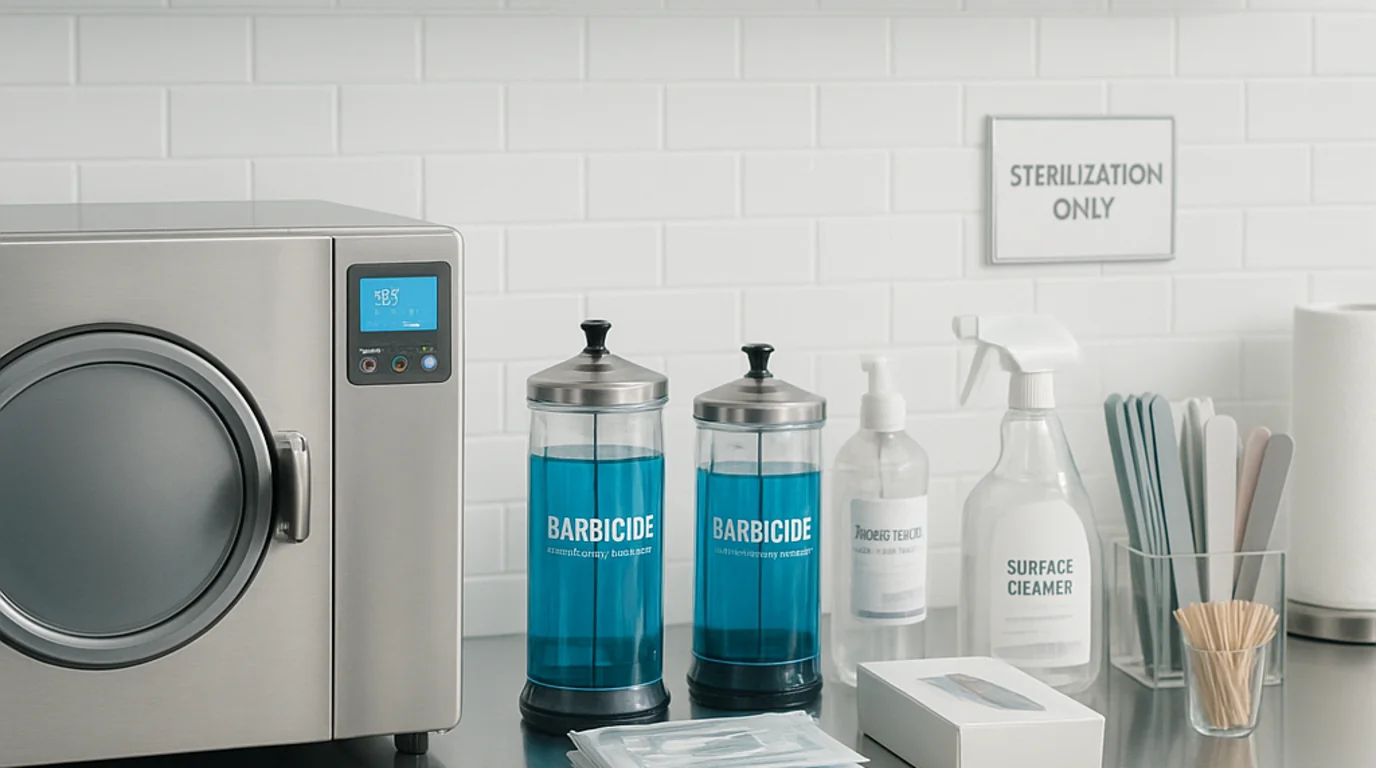
A single mycobacterium infection traced back to a pedicure basin can shut down a nail salon permanently. It has happened in Texas, California, and Virginia. The fines are steep, the lawsuits are worse, and the reputational damage never heals. Sanitation is the legal foundation your business runs on.
Nail Salon State Board Sanitation Requirements
Every state cosmetology board sets its own sanitation rules, but the core requirements overlap. Virginia’s 18VAC41-20-270 is representative: all implements that contact skin or nails must go through a four-step process after every client. Step one, clean with soap and water to remove visible debris. Step two, disinfect with an EPA-registered hospital-grade disinfectant. Step three, rinse with clean water and dry with a clean towel. Step four, store in a clean, dry, closed container until the next use.
Texas requires salons to post health and safety rules publicly and maintain them in writing (TDLR Health and Safety Rules). California’s Board of Barbering and Cosmetology mandates that all implements be visible to clients during the disinfection process. New York conducts surprise inspections and can issue immediate closures for violations.
Common inspection failures include unlabeled disinfectant containers, expired products, incomplete pedicure basin logs, dirty nail files stored alongside clean tools, and technicians who cannot locate Safety Data Sheets (SDSs).
EPA-Registered Disinfectants for Nail Salons
Federal law is clear on this point. Any disinfectant used on salon implements must carry an EPA registration number and must state on its label that it is bactericidal, virucidal, and fungicidal. Using the product at a different dilution ratio than the label specifies is a federal violation, regardless of what your state board says.
Barbicide Concentrate is the industry standard. It is EPA-registered as a hospital-grade germicide effective against HIV-1, Hepatitis B and C, MRSA, Staphylococcus aureus, and Pseudomonas aeruginosa. The required dilution ratio is 1:16 (one ounce of concentrate per 16 ounces of water). Contact time is 10 minutes of complete immersion. The solution must be replaced daily. Reusing yesterday’s Barbicide is a violation, and inspectors test for this by checking color intensity.
CaviCide is a surface disinfectant widely used for workstations, arm rests, and non-immersible equipment. It comes ready-to-use (no mixing), kills TB, HIV, HBV, and HCV, and requires a three-minute contact time on hard surfaces. It is particularly useful for quick turnovers between clients on surfaces that cannot be submerged.
Always verify the EPA registration number on the label before purchasing any disinfectant. No EPA number means it is not legally compliant for salon use.
Autoclave vs. Chemical Sterilization in Nail Salons
Disinfection and sterilization are not the same thing. Barbicide reduces microbial load but does not eliminate bacterial spores. Sterilization destroys all microbial life, including spores. For implements that pierce or abrade skin (nippers, cuticle pushers, callus removers), sterilization is the higher standard.
Autoclave sterilization uses pressurized steam at 250 to 275 degrees Fahrenheit (121 to 135 degrees Celsius) for 15 to 30 minutes. This method kills 100% of bacteria, viruses, fungi, and spores by denaturing proteins at the cellular level. The Tuttnauer EZ9Plus is a popular tabletop autoclave for nail salons, offering a 9-inch chamber that fits standard nail tool pouches and runs a complete cycle in about 25 minutes.
Currently, only three states (Texas, New York, and Iowa) require autoclaves in nail salons by law. California, Florida, and several other states strongly recommend them. Regardless of your state’s minimum requirement, autoclave use signals a higher standard of care to clients and provides stronger legal protection if an infection claim arises.
Dry heat sterilization avoids the moisture problem. Autoclaves introduce steam that can rust metal tools over time. Dry heat sterilizers use heated air at 320 to 340 degrees Fahrenheit for 60 to 120 minutes. The longer cycle time is the tradeoff, but tool longevity improves.
Chemical sterilization using glutaraldehyde-based solutions is falling out of favor due to toxicity concerns. The required immersion time is typically 10 hours for true sterilization, making it impractical compared to an autoclave cycle.
Single-Use Items: No Shortcuts
Certain items must never be reused, period. This list is consistent across virtually every state board:
- Nail files and buffers (unless they have a disinfectable metal or glass core)
- Wooden cuticle pushers and orangewood sticks
- Toe separators (foam type)
- Cotton balls, gauze, and wipes
- Disposable gloves
- Paper towels used as a work surface liner
Porous items cannot be fully disinfected. A nail file that has absorbed skin cells and moisture is a bacterial reservoir no matter how long you soak it. Buy single-use supplies in bulk to keep per-unit costs low.
How to Clean and Disinfect Pedicure Basins
Pedicure basins are the highest-risk equipment in any nail salon. The EPA’s recommended procedures for foot spa basins are specific and widely adopted by state boards.
Between every client:
- Drain the basin completely and remove all visible debris.
- Scrub interior surfaces with soap or detergent.
- Rinse with clean water and drain.
- Fill with clean water and add an EPA-registered hospital-grade disinfectant.
- For whirlpool and jetted models, run the jets for the full 10-minute contact time (or the time stated on the disinfectant label) so the solution circulates through all internal plumbing.
- Drain, rinse with clean water, and wipe dry with a clean towel.
At the end of every day:
- Remove the filter screen, inlet jets, and all removable parts.
- Scrub each part with a brush and soap or disinfectant solution.
- Rinse, reassemble, and fill the basin with clean water and disinfectant.
- Circulate for at least 10 minutes, then drain and air dry overnight.
Some states, including California and Texas, also require a weekly deep flush using a bleach solution with an 8-hour or longer contact time. Check your state board’s specific requirements on this point.
Pipeless and non-whirlpool basins follow the same between-client protocol but skip the circulation steps. The simpler plumbing reduces bacterial hiding places, which is why many newer salons are switching to pipeless designs.
Nail Salon Sanitation Documentation and Logs
Records separate a salon that passes inspection from one that gets fined. State boards require the following:
Pedicure cleaning log. Record the date, time, disinfectant used, and the legible signature and license number of the technician who performed the cleaning. California publishes a standard log form. Most states require 12 months of logs kept on-site.
Safety Data Sheets (SDSs). OSHA requires an accessible SDS binder for every chemical used in your salon. Inspectors will ask a randomly selected technician to locate and explain an SDS. Failure is a citable violation.
Employee license records. Every technician’s current, valid license must be on file and posted visibly. Expired licenses are among the most common citations.
Disinfectant inventory records. Track product names, EPA registration numbers, purchase dates, and expiration dates. This proves compliance at the time of inspection.
Autoclave spore test logs. If you use an autoclave, run biological indicator (spore) tests weekly and keep the results. This is the only way to verify sterilization temperatures are being reached. The Tuttnauer line includes built-in cycle printouts that serve as additional documentation.
Create a binder or digital system with tabs for each category. Assign one staff member per shift to handle documentation. When an inspector walks in, that binder is the first thing you hand over.
Training Staff on Salon Sanitation
Sanitation is not a task you check off once. It is a continuous practice built into every service. Train every new hire on your four-step disinfection process, pedicure basin protocol, and documentation system before they touch a client. Run monthly self-audits using your state board’s published inspection checklist. Replace disinfectant solutions daily, not when they look cloudy.
The salons that get shut down are not the ones that never learned the rules. They are the ones that let the standards slip on busy Saturdays. Proper sanitation goes hand in hand with nail salon ventilation — both are inspected together by most state boards. If you are opening a new salon, our starting a nail salon guide covers sanitation setup from day one.