A comped manicure for your sister costs you nothing. She is family, the chair looked empty, and she will tell her friends about your work. Every nail salon owner has heard some version of this argument. Most of them have given the manicure.
The ledger disagrees. A free service still consumes product, still occupies a chair, and still bills exactly zero dollars. The nail salon friends and family discount is the quietest revenue leak in the business, because no report ever names it.
The Myth: The Nail Salon Friends and Family Discount Is Free
The discount feels free because no money changes hands. No coupon prints, no terminal beeps, no line on a receipt. A cash discount program at least shows up somewhere: the client sees the fee, the owner sees the policy, the processor documents the rules. A comp disappears. One week the salon takes $53 for a mani-pedi, the next week the same service rings out at zero and nobody flags it.
The myth survives because it is never measured. An owner who would not run a 20 percent flash sale without checking the margin will hand out the same value in free work without a second thought. That is the whole problem in one line: comps are discounts that skipped the approval process.
Why the Cost of Free Nail Services Gets Ignored
Three rationalizations carry the habit.
The empty-chair argument. “The slot would have sat empty anyway.” Sometimes true, rarely checked. The average mani-pedi runs $53, and the salon with genuinely empty chairs is not usually the one giving services away. When a chair is empty, the fix is the one this site laid out in the discount trap analysis: fill the gap without cutting the price.
The family argument. “Family takes care of family.” The direction matters. The salon is doing the taking care of, every single time, in one direction only. Salon coach Maddi Cook’s breakdown of mates rates puts a number on it: a modest discount every four weeks costs £260 a year from one person’s pocket, and that pocket never gets refilled. Most owners comp far more than one person.
The invisibility argument. No monthly review flags free services. The cost lives only in the owner’s memory, and memory is generous.
What One Comped Service a Week Actually Costs
Run the number the way you would run any other pricing decision. The national average mani-pedi combo runs about $53, per Zenoti’s salon pricing guide. One comped service a week:
- 52 comps a year at $53 equals $2,756 in revenue that never books
- Product runs $4 to $6 per service, so $208 to $312 a year in supplies vanish
- An hourly tech still gets paid $8 to $12 for that slot, so $416 to $624 a year in labor bills against a zero-dollar ticket
$2,756 is the floor. The slot that held your sister could have held a paying client, which makes the true cost the ticket price plus the appointment it displaced. Scale it and it compounds: two comps a week is $5,512, and one per tech in a four-chair salon passes $11,000 a year. The average US nail salon takes in $285,000 a year. Eleven thousand is roughly 4 percent of that revenue, given away with no receipt.
The resentment cost sits on top. In a commission shop, the tech just worked an hour for free. Twice a month, that is a pay cut the owner handed to someone else, and the tech knows exactly whose guest it was.
How to Say No to Family Discounts at a Nail Salon
The scripts work only when the answer is already decided. Decide once, in writing, and the conversation stops being a negotiation. It becomes a policy read aloud.
- “I do not discount services for anyone. Not for my mother, not for you. I will book you a Tuesday slot and give you the full hour.”
- “The friends and family rate is the same as the regular rate. Supporting the business is the favor.”
- “I would love to do your nails. I charge you what I charge everyone, because the day I charge you less is the day my other clients pay for your visit.”
Send the preemptive message before anyone asks. Entrepreneur’s guide to handling family and friend discount requests recommends a short text to the inner circle stating that prices are the same for everyone and that referrals are how they can help. One message removes most of the awkwardness, because the ask never happens.
A Salon Friends and Family Discount Policy That Holds
Write the policy down. It is short, it lives in the employee handbook, and it binds the owner as much as the staff:
- Immediate family only. A defined list, not a vibe.
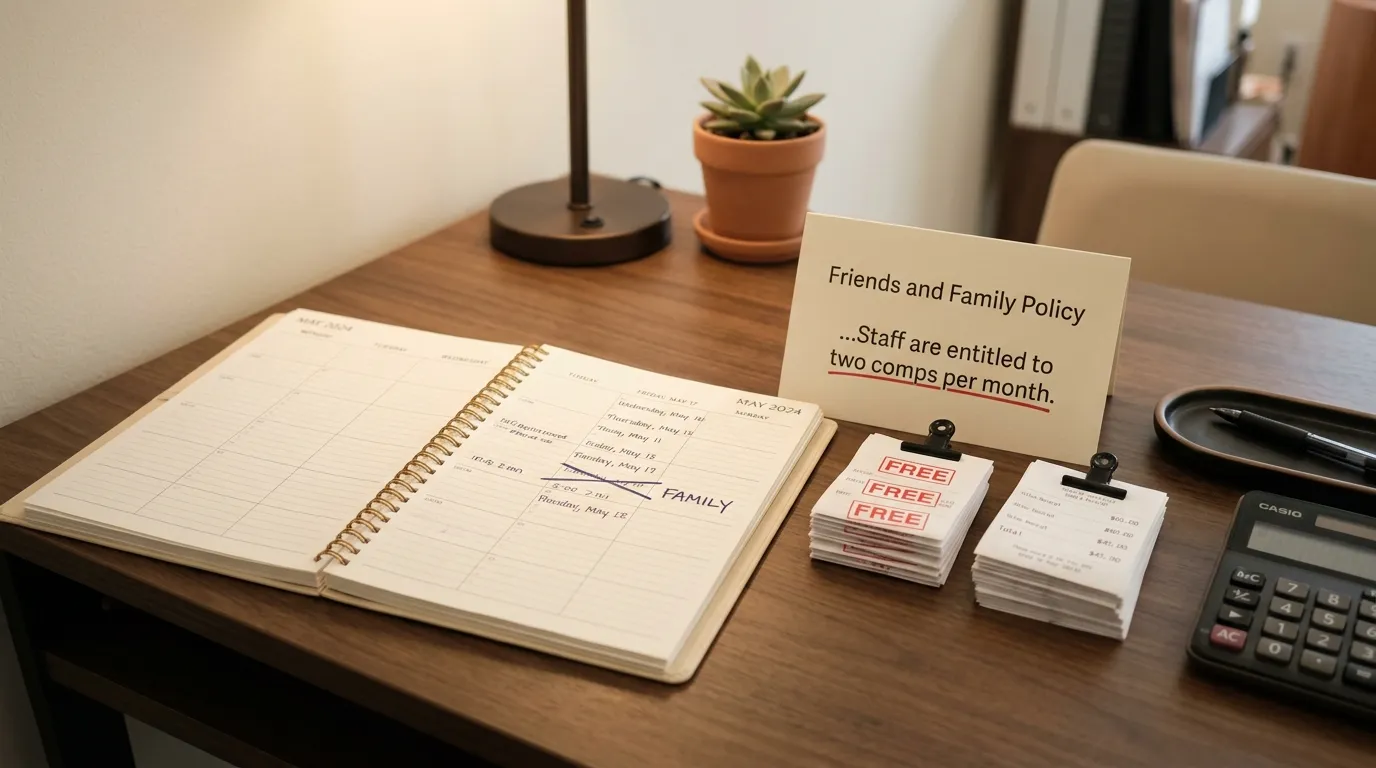
- Two comped services per month, maximum, logged in the POS under a code the owner reviews.
- Comped appointments book through the same system as paying clients, into real open slots. No walk-in comps, no squeezing into a full day.
- No-shows and late cancellations cost comps exactly what they cost paying clients.
- Any discount that stays on the menu sits at the cost floor of the service, never below it.
Test every request against the rule Maddi Cook gives owners: would you accept this from any other client? If the answer is no, the answer to your sister is no.
A written policy protects the relationship better than a free manicure ever will. Set it once, on paper, while nobody is in the chair, and the question stops coming up at Thanksgiving.