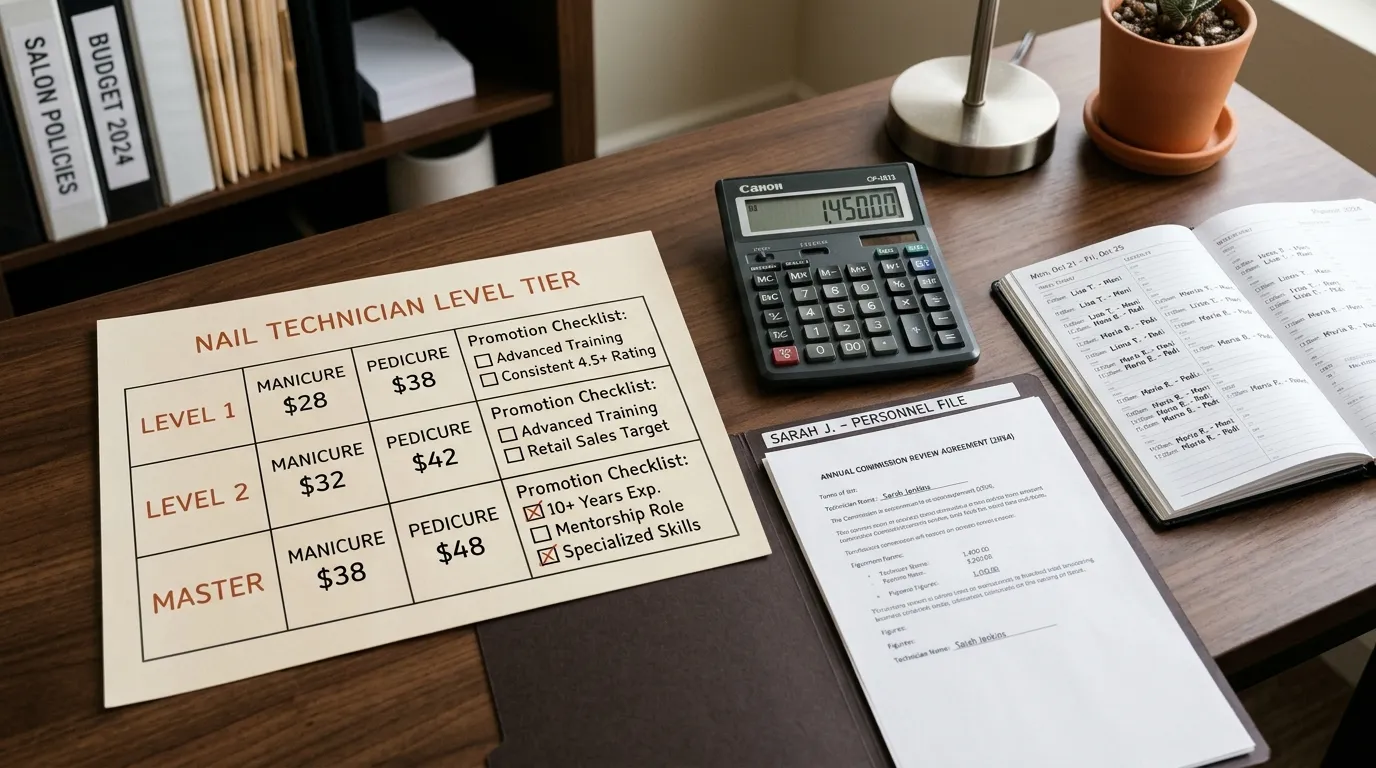
Charging every tech’s clients the same price and paying every tech the same split looks fair on a poster and fails on a payroll sheet. NAILS Magazine ran the composite: a 50 percent commission off a $25 service, plus a 13.5 percent payroll burden, 4 percent for supplies, and 2 percent in card fees, sends roughly two-thirds of revenue out the door before rent gets paid. A nail salon level system repairs that arithmetic by splitting the floor into three tiers, junior, mid-level, and master, each with its own menu prices, commission split, and posted promotion criteria. The benchmarks, the menu math, and the promotion mechanics follow.
What a Nail Salon Level System Changes About the Payroll Math
The flat 50 percent split became the industry default through the ’80s and ’90s, and it survives on simplicity. Simplicity is also its defect. A new hire starts at the ceiling on day one, which leaves the salon one raise to offer later: a counteroffer when she is already halfway out the door. NAILS Magazine’s pay-structure analysis notes that technicians will move for a couple of commission points, and a flat structure gives them nothing to move up to, only away to.
Exit interviews repeat the pattern. MR SPA’s rundown of why nail technicians jump salons ranks insufficient income first, then stagnant pay scales, income gaps between techs on the same floor, and the absence of challenges or structured training. Every one of those drivers describes a shop with a flat line where a ladder should be.
A level system replaces the line with three rungs. Juniors carry the volume services at prices new clients accept. Masters carry the complex work at prices the work finally justifies. The split steps up only where the price supports it, and promotion happens on posted criteria rather than on threat of resignation.
The Nail Tech Level System: Benchmarks for Each Tier
The nail tech level system below is the working version; move the tenure gates to fit your market, and keep the three-rung shape. Two tiers leave no middle to promote into. Four make the menu unreadable.
Junior: Year 0 to 1
Fresh from the license or new to the salon. The scope is the volume menu: manicures, pedicures, gel polish, polish changes. Pay runs hourly or on a guaranteed base during the ramp, then commission at the junior split. Four gates clear before she moves up: every core service signed off on a model, a gel service finished inside its booked slot, redo flags on fewer than 1 in 20 sets for a full quarter, and rebooking at 30 percent or better.
Mid-level: Year 2 to 3
The core rung, where enhancements come on: Gel-X and acrylic full sets, builder gel, e-file refills, most of the art menu. The split rises to 45 to 50 percent. Gates to master: sculpted work and a correction case signed off by a current master, a photo portfolio of 20 finished sets, rebooking at 40 percent or better.
Master: Year 4 and Beyond, or the Certified Path
Sculpted acrylic, correction work, long extensions, advanced art, plus the mentoring file: masters train juniors and sign off their gates. The split runs 55 to 60 percent, and the price band that funds it lives on the premium menu below.
| Tier | Gate in | Services | Split |
|---|---|---|---|
| Junior | 0 to 1 years, core sign-off | Manis, pedis, gel polish | 40% |
| Mid-level | 2 to 3 years, enhancement sign-off | Full sets, refills, most art | 45-50% |
| Master | 4+ years or advanced certification | Sculpting, corrections, advanced art | 55-60% |
Salon Tiered Pricing for Nail Services: The Menu Math
Salon tiered pricing for nail services works when the price step funds the split step. Boulevard’s 2026 price benchmarks put a gel manicure at $30 to $45, a standard manicure at $20 to $40, a deluxe pedicure at $50 to $80, and acrylic infills at $20 to $45. A three-rung ladder lands inside those bands without inventing a single new service:
| Service | Junior | Mid-level | Master |
|---|---|---|---|
| Gel manicure | $35 | $40 | $45 |
| Acrylic or Gel-X full set | $45 | $55 | $70 |
| Infill | $25 | $30 | $40 |
| Deluxe spa pedicure | $50 | $55 | $65 |
Run one service across the ladder. The gel manicure takes 45 minutes and carries $5 in product at the standing per-service benchmark:
- Junior, $35 at a 40 percent split: she earns $14.00; the salon collects $21.00, or $16.00 after product.
- Mid-level, $40 at 50 percent: she earns $20.00; the salon keeps $15.00 after product.
- Master, $45 at 55 percent: she earns $24.75; the salon keeps $15.25 after product.
Her take climbs $10.75 across the ladder while the salon’s dollar per service moves 75 cents. Per hour, she rises from $18.67 to $33.00 against the $17.19 median for manicurists per O*NET’s 2025 data. That is the design: the raise is funded by the price step, so the split never steps up without one.
Two rules keep the ladder honest. No rung prices below the cost floor, which the per-service pricing formula sets from product, labor, and overhead before any tiering begins. And the master rung earns its keep on premium work: a $70 sculpted set at a 55 percent split leaves the salon $26.50 after product, nearly double the gel manicure’s contribution. Book masters toward that work.
Junior vs Master Nail Tech Pay: Splits That Hold Up
Junior vs master nail tech pay breaks in the details, so post the details. The full ladder, title, split, price band, promotion criteria, belongs on the break-room wall and in the offer letter. Three mechanics hold it up.
Pay juniors a guaranteed minimum while the book builds. The first-hire guide suggests a $600 weekly guarantee during ramp-up, and the ladder converts it to commission at the junior split once booked hours hold. If her hours at $35 cannot clear the $17.19 median, the ladder is priced wrong and the split is the wrong lever.
Review for promotion on a fixed calendar, every six months, with moves effective on menu-reprint dates. NAILS is blunt about the alternative: a technician who cannot see the next raise inside the salon finds it down the street. A posted rung with posted criteria ends the counteroffer conversation before it starts.
Step the splits 5 points at a time, only alongside the matching price step. Commission paid to W-2 employees carries employer payroll burden on top, the 13.5 percent line in NAILS’ composite, so a master split charged at junior prices loses money on the service line. What emerges is a nail salon commission structure by experience, legible to every chair on the floor.
Putting the Tiers on the Menu Without Cheapening Junior Work
Name the tiers neutrally: Level 1, Level 2, Master, or New Talent, Salon Tech, Master Tech. Words like budget and basic teach the client to read the junior price as a sale price. The junior rung is an entry price set by experience, and it holds all week.
Show the tier at booking. Systems that let a client pick her tech by name and price make the tiering mechanical, and the multi-tech scheduling guide covers routing new clients to the right chair. Route by need as well: length and correction requests book the master, gel maintenance books any tier, and juniors take the walk-in rotation until their books hold.
Script the desk so no tech defends her rung: “Level 1 is $35, Level 2 is $40, and master techs are $45 for the same gel service. The level reflects years at the table and the range of work each tech carries.” Announce the change the way any price change goes out: Boulevard’s guidance is at least 30 days of notice, posted at the desk, with the printed menu, website, and booking platform updated at the same time, and annual ladder reviews of 5 to 10 percent after that.
The gel manicure ladder compresses into two numbers. The tech’s hourly rises from $18.67 to $33.00 between the bottom rung and the top while the salon’s dollar per service never leaves the $15 to $16 band. A level system funds the raise from the menu, which is where the raise was always going to come from.