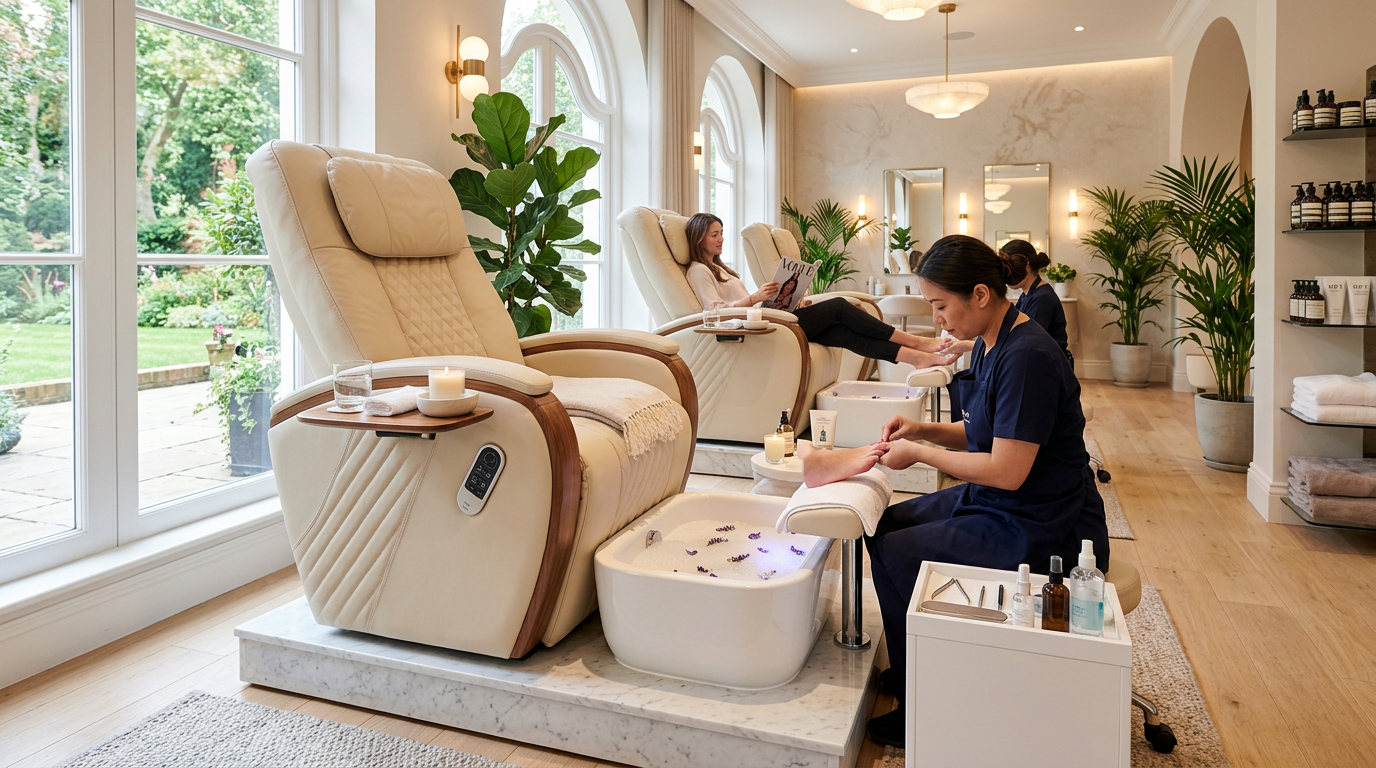
Pedicures are one of the most requested services in any nail salon. They also have some of the worst revenue-per-hour numbers on your menu. A basic pedicure takes 45 to 60 minutes, ties up an expensive chair, and brings in $30 to $50. Meanwhile, a gel manicure takes 30 minutes and earns nearly the same amount.
If pedicures are eating your schedule without pulling their weight financially, the fix is not to drop them. It is to restructure how you price, deliver, and upsell them.
Why Pedicures Have Low Profit Margins
The metric that matters most for service profitability is revenue per technician hour (RPTH). A well-run nail salon should target $60 or more per technician hour. Here is where common pedicure services land:
| Service | Typical Price | Time | Revenue/Hour |
|---|---|---|---|
| Basic pedicure | $35 | 50 min | $42 |
| Spa pedicure | $55 | 60 min | $55 |
| Gel pedicure | $60 | 55 min | $65 |
| Deluxe spa pedicure | $80 | 70 min | $69 |
| Basic manicure (comparison) | $25 | 25 min | $60 |
| Gel manicure (comparison) | $45 | 35 min | $77 |
The basic pedicure at $42/hour is dragging your average down. Your technicians could serve two gel manicure clients in the same time and generate $90 instead of $35. That gap compounds across a full day and a full team.
The solution is not to eliminate basic pedicures. Some clients want them and will leave if you do not offer them. The solution is to build your pedicure menu so that the basic option is the least attractive choice.
How to Build a Profitable Pedicure Menu
Tiered pricing steers clients toward higher-value services without making them feel pressured. Structure your menu with three clear levels:
Tier 1: Classic Pedicure ($35 to $45). Soak, nail shaping, cuticle care, callus removal, basic lotion, polish. Keep this option on the menu but do not promote it. It exists as an anchor that makes Tier 2 look like a deal.
Tier 2: Signature Pedicure ($55 to $70). Everything in Tier 1 plus a sugar or salt scrub, extended 10-minute leg and foot massage, hot towel wrap, and a premium polish option. This should be your default recommendation. The material cost difference between Tier 1 and Tier 2 is roughly $3 to $5, but you are charging $20 to $25 more. The extra time is only 10 to 15 minutes.
Tier 3: Luxury Pedicure ($80 to $100+). Everything in Tier 2 plus paraffin wax treatment, hydrating mask, aromatherapy, extended 15-minute massage, and gel polish. Price the jump from Tier 2 to Tier 3 at $15 to $25. When the gap is small relative to the extras, clients regularly trade up. This tier should hit $69 to $85 per hour.
Most clients will choose Tier 2. That alone shifts your pedicure RPTH from $42 to $55 or higher.
Best Pedicure Upsells and Add-Ons
Add-on services are where the real margin lives. Product costs are low, time investment is minimal, and clients genuinely enjoy them. The key is offering them at the right moment, not before the service starts, but while the client is relaxed and already in the chair.
Paraffin wax treatment ($10 to $20 add-on). Takes 5 to 7 minutes of passive time (the wax sits while the tech works on other steps). Product cost is under $2 per dip. Paraffin softens skin and makes the pedicure result look and feel noticeably better. Offer it by saying, “Your skin is a little dry today. Want me to add a paraffin dip? It will make a big difference.” Acceptance rates run 30% to 40% when offered naturally.
Gel polish upgrade ($10 to $15 add-on). Adds 5 to 10 minutes for curing. Product cost is $2 to $3 more than regular polish. The sell is easy: “Gel lasts two to three weeks with no chipping. Want me to switch to gel today?” Clients who try gel on a pedicure almost always come back for it.
Extended massage ($10 to $15 add-on for an extra 10 minutes). Zero product cost. Pure labor, but at $60 to $90 per hour of incremental revenue. Extended massage add-ons improve circulation and encourage relaxation, making the experience feel worth the extra spend.
Callus peel or treatment ($15 to $20 add-on). Chemical callus removers work in 5 minutes and deliver dramatic results. Product cost is $1 to $3 per application. Clients with rough heels will say yes immediately.
Nail art on toes ($5 to $15 per design). Quick accent designs on the big toe take 3 to 5 minutes. Nearly pure profit.
A single add-on turns a $35 basic pedicure into a $50 service. Two add-ons push it to $60 or $65. That is the difference between a service that loses you money and one that earns its place on the schedule.
Average ticket increases of 25% to 50% are realistic when your team consistently offers add-ons.
Speed Up Your Pedicure Workflow
Profitability is not only about what you charge. It is also about how efficiently you deliver. A pedicure that should take 50 minutes but routinely runs to 65 minutes because of disorganized workflow costs you money on every single appointment.
Prep the station before the client sits down. Towels laid out, water running, tools sanitized and arranged. The client should go from greeting to soaking in under two minutes.
Use a pedicart or rolling cart. Pedicarts with organized compartments eliminate the back-and-forth trips to supply cabinets. Every trip to grab a missing tool adds 1 to 2 minutes. Across 8 pedicures a day, that is 10 to 15 minutes of wasted time.
Overlap passive steps. While paraffin sets, work on cuticles. While a mask soaks, shape and buff nails. While gel cures under the LED lamp, clean up the station for your next client. A well-sequenced pedicure where passive and active steps overlap can shave 5 to 10 minutes off total chair time without cutting any part of the service.
Invest in pipeless pedicure chairs. Pipeless jet systems clean faster between clients than whirlpool models. That cuts 5 to 8 minutes of turnover time per appointment. Over a full day, you gain enough time for one additional booking.
LED curing lamps over UV. LED lamps cure gel in 30 to 60 seconds versus 2 to 3 minutes for UV. If you are doing gel pedicures (and you should be promoting them), this adds up fast.
Run the Numbers on Your Own Menu
Take your current pedicure menu and fill in this table:
| Service | Your Price | Avg Time (min) | Revenue/Hour | Product Cost | Labor Cost (at your hourly rate) | Profit/Service |
|---|
If any service falls below $50/hour in revenue, it needs restructuring. Either raise the price, reduce the time through better workflow, or attach an upsell that lifts the average ticket.
Track these numbers monthly. Your booking software should give you average service time and revenue per service. If it does not, start timing services manually for two weeks to get a baseline. Need help setting up service tracking? See our booking and scheduling guide.
The Bottom Line
Pedicures do not have to be a loss leader. With a three-tier menu, consistent upselling of add-ons that cost you almost nothing in materials, and a tightened workflow, pedicures can hit $60 to $85 per technician hour.
The math is straightforward. A salon running 8 pedicures per day at $42/hour generates $280 in pedicure revenue for roughly 6.5 hours of chair time. That same salon running 8 pedicures at $65/hour with add-ons and tier upgrades generates $420 or more for the same (or less) chair time. That is an extra $140 per day, $700 per week, and over $36,000 per year from one service category.
Stop treating pedicures as a necessary evil. Treat them as a profit center that just needs better structure. For more on getting your service pricing right across the board, read our guide on how to price nail services.