A single traditional pedicure uses 13 to 18 gallons of water, roughly one average shower, according to Fast Company’s report on waterless nail salons. Varnish Lane in Washington, D.C. and Glosslab in New York built multi-location brands on skipping that water. The question for an independent owner is narrower: does a waterless manicure for nail salons clear the math at your prices, with your techs, in your market?
The decision runs on minutes per service, revenue per hour, product cost, and client reaction. Hygiene sits underneath all four, because it is why the trend started.
What the Soak Is Actually Doing
The soak survives on habit. A nail plate absorbs water during three to five minutes in a bowl and swells. Polish goes on the swollen plate and dries while the nail is still expanded, so when the plate shrinks back to size, the bond breaks and the polish lifts. Debbie Doerrlamm, a New York tech who stopped using water more than 20 years ago, put it to NAILS Magazine plainly: the polish dries before the nail does, and when the nail returns to its natural curl, off comes the polish.
Consultant Terri Taricco ran her own wet-versus-dry test on clients and checked the results 10 to 12 days later; the polish on the unsoaked hands lasted longer, per the same NAILS Magazine report on dry manicures.
Hygiene points the same direction. Shared water is the easiest cross-contamination vector in the building. Glosslab’s founder told Fast Company she went waterless because water is “a breeding ground for bacteria and germs,” and built a dry manicure nail salon brand on that logic, with no water service at all. Varnish Lane’s founders, after consulting industry experts, concluded water is the biggest infection source in mani-pedi work, and that bacteria can persist in foot-spa jet lines even when basins are cleaned between clients. The four-step disinfection chain in this site’s sanitation protocol guide still applies to every metal implement either way. Removing the soak takes the bowl out of that chain entirely, along with the daily solution changes and the disposable liners.
The Waterless Manicure Benefits That Change the Numbers
Time comes first because time is what a chair sells. The Lutily wear-and-time comparison logged traditional manicures at 45 to 60 minutes against 30 to 45 for dry prep, and the tech who ran it said dropping the bowl gave her back about ten minutes per client, enough to add a slot a day. The same comparison logged regular polish lasting 9.5 days before the first chip on dry-prepped nails against 6.2 on soaked ones, with gel running about a week longer.
Run the capacity math. A gel manicure averages $35 to $60 in the US, per Zenoti’s salon pricing guide. An eight-hour chair booked in 60-minute slots holds eight services; booked in 45-minute slots it holds ten. Those two extra slots are $70 to $120 of daily capacity per chair. On a six-chair floor running six days, that is $2,520 to $4,320 a week of capacity the soak makes the schedule structurally unable to hold. Filling it depends on demand. Holding it depends on deleting the bowl.
The cost side needs no offsetting spike. The minimal version of the switch requires no new kit: techs quoted by NAILS Magazine say they simply remove the soak step from the system they already run. The upgraded version adds cuticle remover, cuticle oil, and heated mitts. Water and laundry drop too; Varnish Lane saves 15 gallons per pedicure and 5 to 10 per manicure, and a bowl-free service moves fewer towels through the wash. Those savings are small in dollars. The relevant fact is their direction.
Waterless Manicure vs Traditional Manicure on the Menu
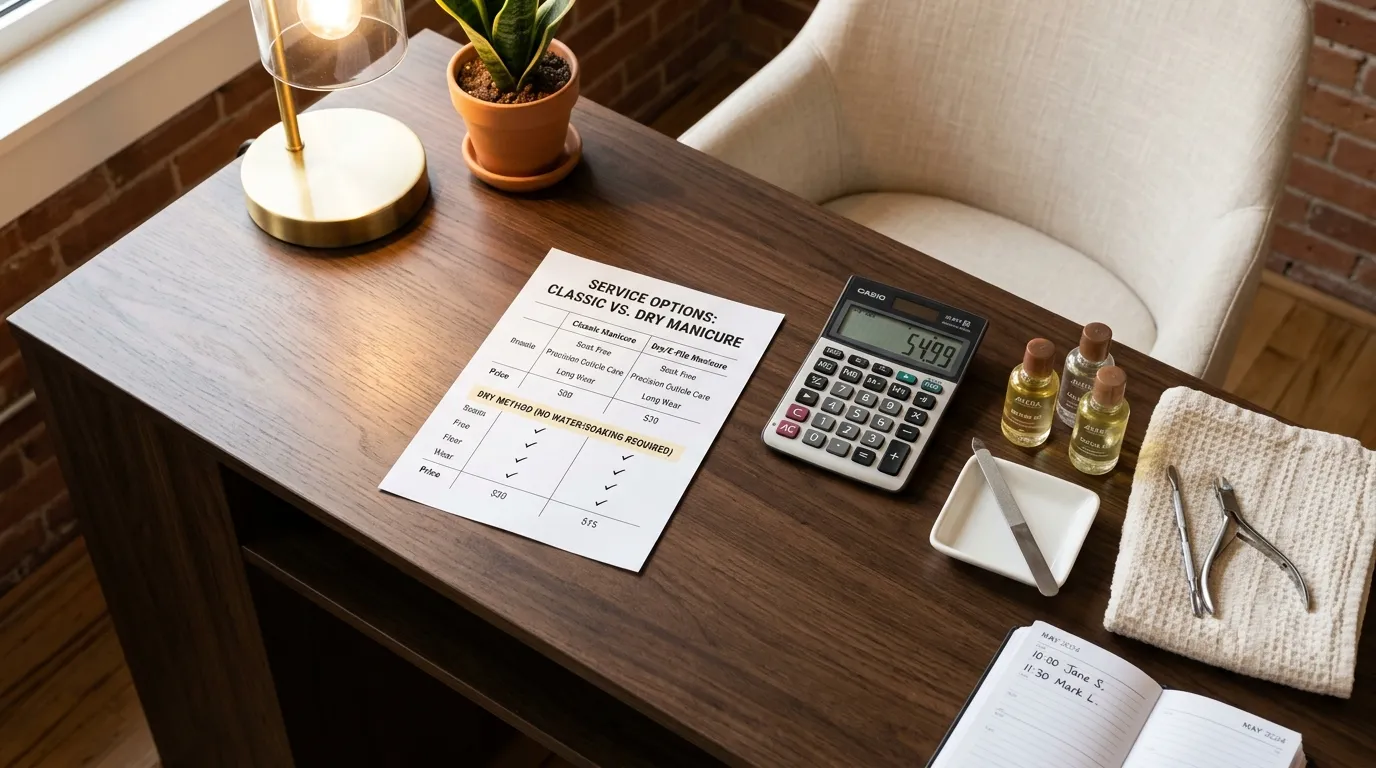
Varnish Lane’s posted menu shows what the market tolerates: $24 for an express polish change, $30 for the classic waterless manicure, $52 for the deluxe, and $52 to $72 with gel. Zenoti benchmarks a US basic manicure at $25 to $45. A waterless manicure priced at the top of that band is unremarkable where two chains charge it daily. Waterless manicure pricing for a salon that already stocks oil and remover is mostly a positioning decision, and the position has a script: the polish lasts longer, so the client buys fewer corrections and fewer mid-cycle appointments.
The script matters because this is where switches fail. Doug Schoon, then head of R&D at Creative Nail Design, told NAILS Magazine that many clients don’t feel they’ve had a good manicure unless the nails were soaked. The techs who converted their books narrated the change: waterlogged skin blocks moisturizer, the swollen plate is why polish chipped by day five, and the oil-and-heat prep is an upgrade in its own right. One of them reported that clients read the dry version as more pampering once it was explained, and that her male clients, never fond of the bowl, needed no convincing at all.
Segment by nail condition, the way this site’s gel vs acrylic framework matches systems to client lives. Maintenance clients on a two-to-three-week cycle are the target market for dry prep; their cuticles need no three-minute soak. Keep the bowl for the client who walks in after six months of neglect and for the ones who book the ritual. The Lutily tech kept hers for exactly that client, and the arithmetic agrees: losing a regular over five gallons of water is a bad trade.
Running the 30-Day Pilot Before You Print the Menu
The how-to for a waterless manicure is mostly deletion, which is why the pilot costs nothing. Two techs, gel manicures only, dry prep for 30 days. Add the service the way this site walked through the dip powder rollout: with the equipment already on the shelves and a decision date on the calendar. Gel clients rebook on a fixed cycle, so wear feedback arrives within one rebooking. Track three columns: service minutes, first-chip date, client comments. Compare against the same techs’ soak numbers from the month before. If minutes drop by ten and chip complaints drop with them, the capacity math is real on your floor and the menu change prices itself. If the regulars revolt, you spent a month and zero dollars learning it.
Twelve extra slots a day on a six-chair floor, polish that holds about three days longer, and one less vessel to disinfect between clients: the bowl is the most expensive thing on the station that nobody charges for, and taking it out costs nothing.